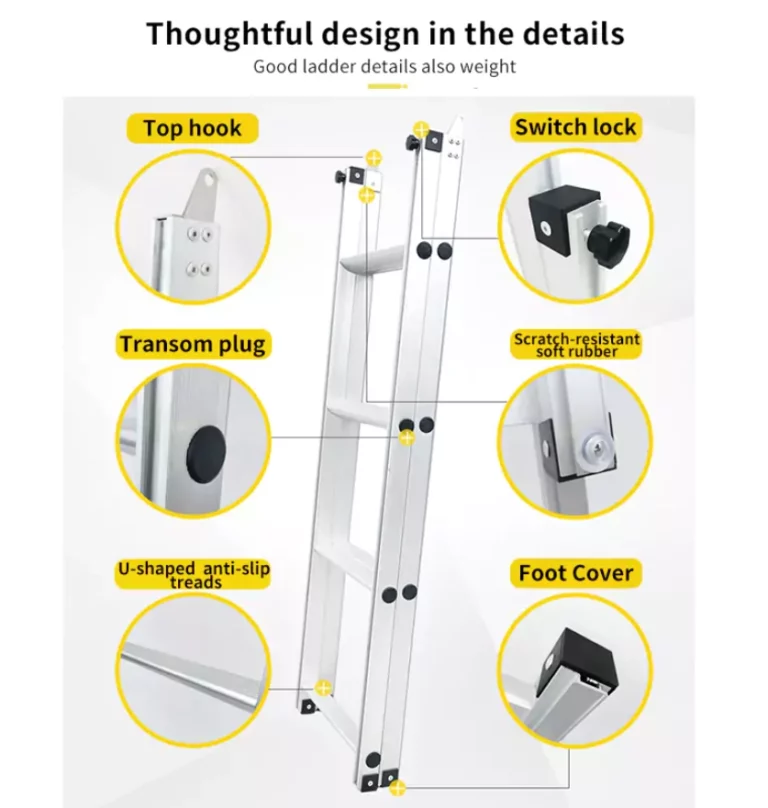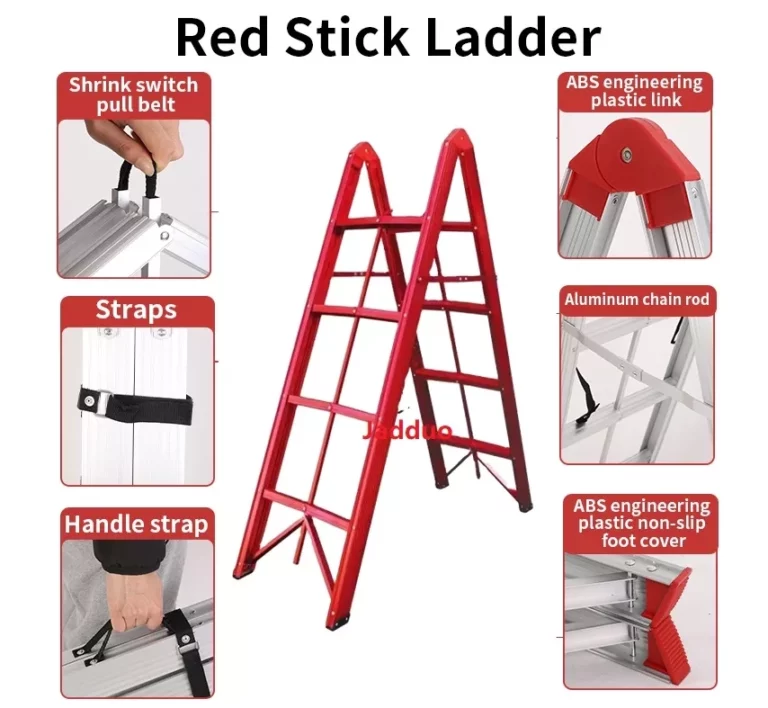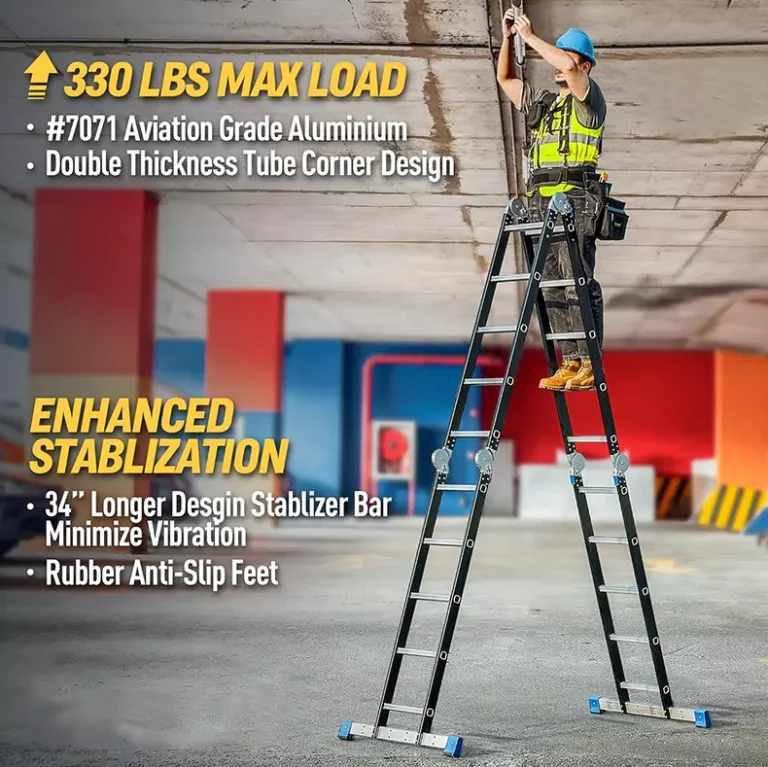
High-rise window cleaning is a demanding task that leaves little room for error. Working several meters above ground, often with water, tools, and movement involved, places safety at the center of every decision. A scaffolding ladder, when chosen and used correctly, offers a stable and flexible solution for professional window cleaning at height.
This guide explains how to safely use a scaffolding ladder for high-rise window cleaning, covering common risks, ladder selection, setup methods, daily work habits, and long-term maintenance. Throughout the article, practical examples from Jadduo’s aluminum scaffolding ladder range are included to show how the right equipment supports safer work on real job sites.
Why Choose a Scaffolding Ladder for Window Cleaning?
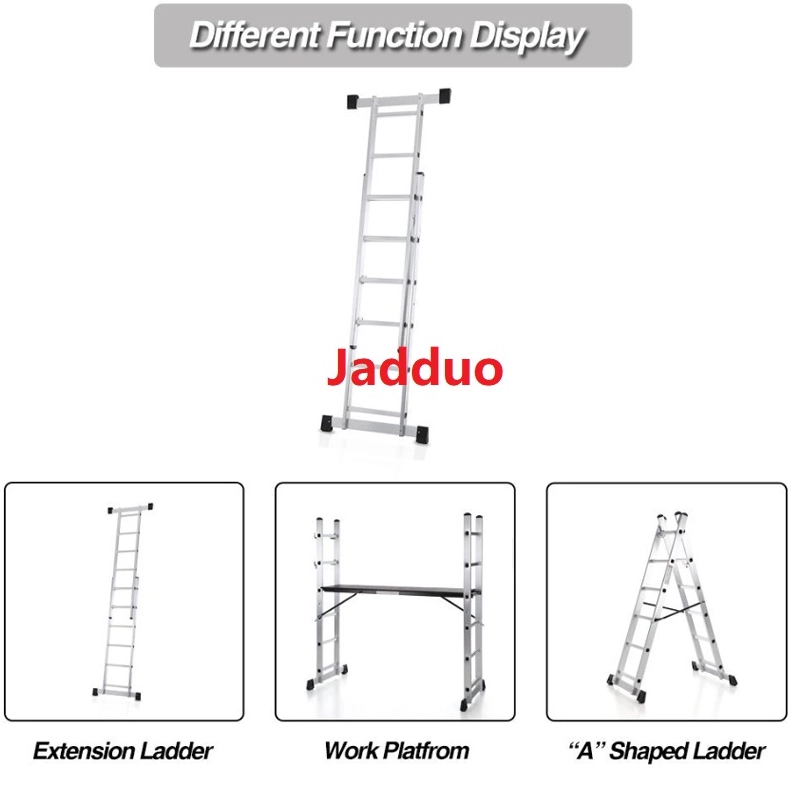
When addressing outer panes or lofty indoor areas such as entrance halls, a universal method often proves inadequate. A scaffolding ladder essentially serves as the adaptable counterpart in the equipment domain. It resolves major challenges—such as cumbersome dimensions and constrained extension—through multiple configurations within a unified structure.
Versatile 3-in-1 Transformation for High-Altitude Access
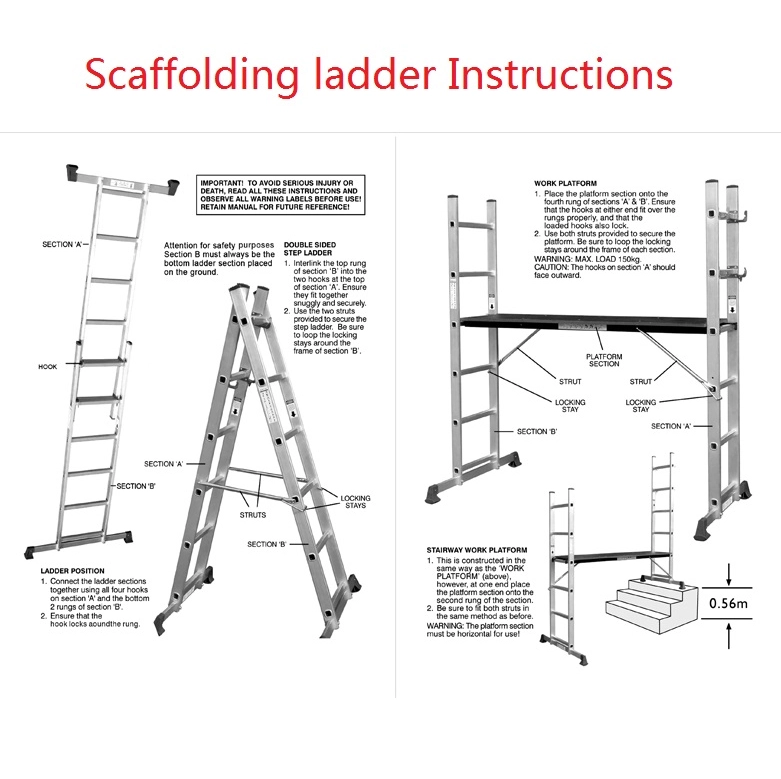
The appeal of this implement stems from its adaptability. You can secure it as an extended ladder to reach elevated drain channels, configure it into an A-shaped frame for panes at intermediate levels, or establish it as an expansive operational surface. This surface configuration proves essential for prolonged maintenance tasks since it provides ample area for lateral movement without the repeated necessity of descending to adjust the ladder’s position.
Lightweight Aluminum Design for Easy Portability
No individual desires to transport a cumbersome 40-pound steel unit across a dwelling. Numerous superior variants utilize a robust aluminum composite that maintains mass between 8kg and 12kg. Although sufficiently portable for a solitary user to convey alongside their body, it nonetheless sustains up to 150kg, ample for an operator accompanied by a weighty container of fluid and materials.
Compact Storage for Transporting in Vehicles
Skilled maintenance personnel or amateur enthusiasts with confined storage spaces will value the reduced dimensions these achieve when collapsed. The majority of such ladders contract to approximately one-fourth of their maximum extent—generally near 1.2 meters. Consequently, placement in the rear compartment of a compact automobile or a compact delivery vehicle becomes feasible without requiring an overhead fixture or an oversized conveyance.
Selecting an appropriate ladder variant constitutes merely the preliminary phase. Furthermore, evaluating distinct attributes suited to your particular work location directs attention toward advanced selections offered by prominent suppliers like Jadduo.
Which Jadduo Products Provide the Best Stability and Reach?
Jadduo has established a standing for crafting apparatus capable of enduring the rigors of practical usage. Their assortment encompasses provisions from elementary domestic demands to intensive commercial configurations. Should you require an item that maintains steadiness at ten feet elevation, their designated scaffolding variants merit examination.
Jadduo Aluminum Scaffolding Ladder for Basic High-Reach Tasks
The Aluminum Scaffolding Ladder forms the core element of their series. It is engineered for individuals seeking a dependable, straightforward device that manages routine elevations. Assembly occurs effortlessly, rendering it suitable for accessing second-floor panes in a standard household.
Scaffolding Aluminum Ladder With Handrail and Wheels for Maximum Mobility
In scenarios involving business structures or extensive properties, the Scaffolding Aluminum Ladder With Handrail+Wheels substantially conserves time. The incorporated wheels facilitate rolling the surface parallel to the facade as sections of the panes are completed, while the handrails furnish supplementary assurance during extensions toward edges.
Aluminum Scaffolding Ladder With Handrail for Enhanced Safety
For persons experiencing unease regarding elevations, the Aluminum Scaffolding Ladder With Handrail delivers heightened protection. The availability of a tangible guard to support or seize upon profoundly influences endurance throughout an extended cleaning period.
Acquiring suitable apparatus proves advantageous, yet even optimal ladders can present perils if mishandled. Prior to commencing the wiping process, several safety verifications remain indispensable and must not be omitted.
What Are the Essential Safety Precautions Before Climbing?
A significant portion of ladder incidents arises from minor neglects—such as glossy terrain, an unsecured fastener, or endeavoring to manage excessive loads concurrently. Here, safety functions as a critical imperative rather than an optional guideline; it guarantees a secure descent.
Strict Adherence to Maximum Load Capacities
The urge to accumulate all equipment upon the surface is understandable, but vigilant monitoring of mass is essential. These ladders are certified for solitary occupancy, featuring an aggregate threshold of 150kg. Should you incorporate a substantial pressure washer conduit and multiple brimming containers, the boundary may be approached more swiftly than expected.
Verification of Locking Mechanisms and Surface Stability
Prior to imposing load, meticulously inspect each pivot. The desired confirmation is the distinct “click” denoting complete activation of the securing components. Additionally, allocate a moment to evaluate the substrate; should it exhibit moisture, irregularities, or scattered particulates, displacement will occur upon ascent.
Avoidance of Hazardous Weather and Environmental Conditions
Elevated cleaning operations suit temperate atmospheric conditions exclusively. Deploying an aluminum ladder amidst forceful breezes essentially invites destabilization akin to a propelled sail. Moreover, recognize that aluminum paired with liquid yields a hazardous slickness, necessitating cessation should precipitation commence.
Following the completion of safety assessments, assembly of the apparatus commences. A majority favor the surface configuration for pane maintenance, with a defined procedure ensuring robustness.
How Do You Properly Set Up the Work Platform Mode?
The surface configuration differentiates these ladders from conventional extensible models. It generates a firm “mini-scaffold” permitting even-footed positioning, which substantially alleviates strain on the spine and lower limbs.
Correct Placement of the Metal Anti-Slip Platform
Upon configuring the span, the surface typically spans the steps. Verification of horizontal alignment and secure fastening is crucial. The metallic treads are formulated to retain adherence despite minor dampening from maintenance solutions, although substantial residues warrant removal.
Strategic Positioning for Optimal Working Angles
Should the linear ladder arrangement supplant the surface mode, the “1:4 rule” serves as a vital guideline. For each four units of vertical ascent, the foundation distance from the facade measures one unit. This arrangement preserves gravitational equilibrium appropriately, averting abrupt base displacement.
Proper Use of Handrails and Safety Barriers
When the variant includes handrails, their integration is advisable. Although installation demands a supplementary instant, compliance with elevated safety criteria is assured, alongside provision of indispensable reassurance during pursuit of flawless results.
Establishment constitutes partial effort; the remainder entails awareness of prohibited conduct while elevated. Certain novice errors persist among proficient practitioners.
What Actions Should Be Avoided During Operation?
Practical reasoning extends considerably, yet amid task intensity, relaxation in vigilance occurs readily. Circumventing these three principal restrictions preserves well-being from medical intervention.
Prohibiting Movement While the Ladder Is Occupied
At no point attempt to relocate or nudge the ladder during occupancy of its steps. While seemingly expedient, such action accelerates total overturning. Descent, repositioning, and re-ascent remain the prescribed sequence.
Avoiding the Use of the Ladder as a Bridge
Although appearing resilient as a beam, refrain from applying ladder segments to span intervals between adjacent edifices. The construction precludes such loading, potentially inducing fracture or deformation under duress.
Maintaining Safe Standing Positions on Rungs
Among the most overlooked directives is the “top two rungs” stipulation. Positioning upon the apex is forbidden. Equilibrium is forfeited, lacking supportive contact for lower extremities. Should accessibility from the third inferior step prove insufficient, an augmented ladder is required.
FAQ
Q1: Can I use the scaffolding ladder on a sloped driveway?
A: Such utilization is highly inadvisable. These implements necessitate a planar, firm substrate for secure function. Irregular terrain imposes anomalous tension upon the fasteners, potentially culminating in complete imbalance.
Q2: Is the platform mode safe for two people if we stay under the weight limit?
A: Affirmative denial applies; these ladders are meticulously formulated for individual utilization exclusively. Irrespective of minimal aggregate mass, dual presence induces erratic equilibrium alterations, rendering the surface precarious.
Q3: How do I maintain the ladder if it gets covered in soap and water?
A: As aluminum construction precludes corrosion akin to ferrous materials, rinsing abrasive agents and desiccating connections is nonetheless prudent. Preservation of securing components from abrasive residues ensures seamless actuation.