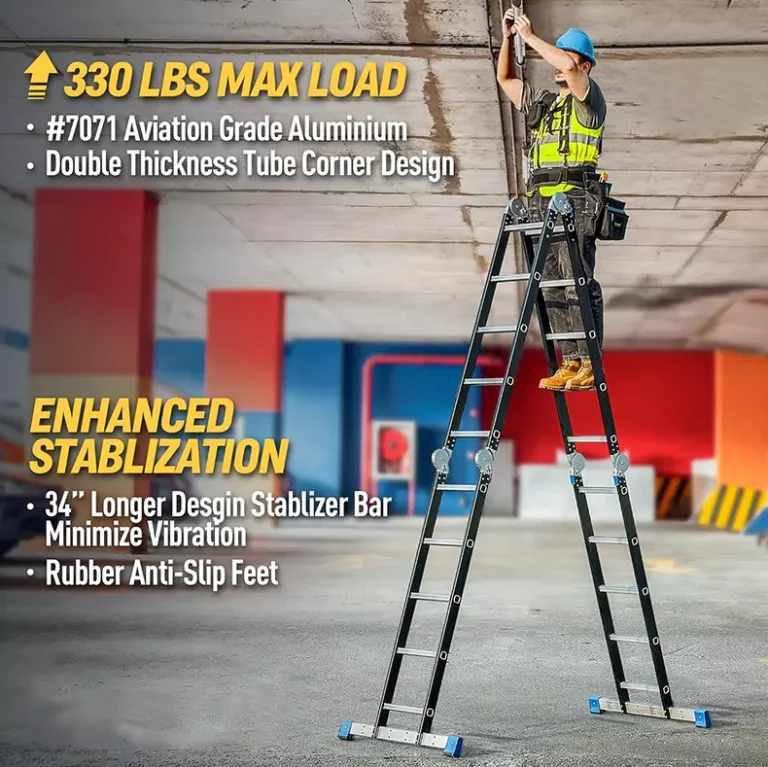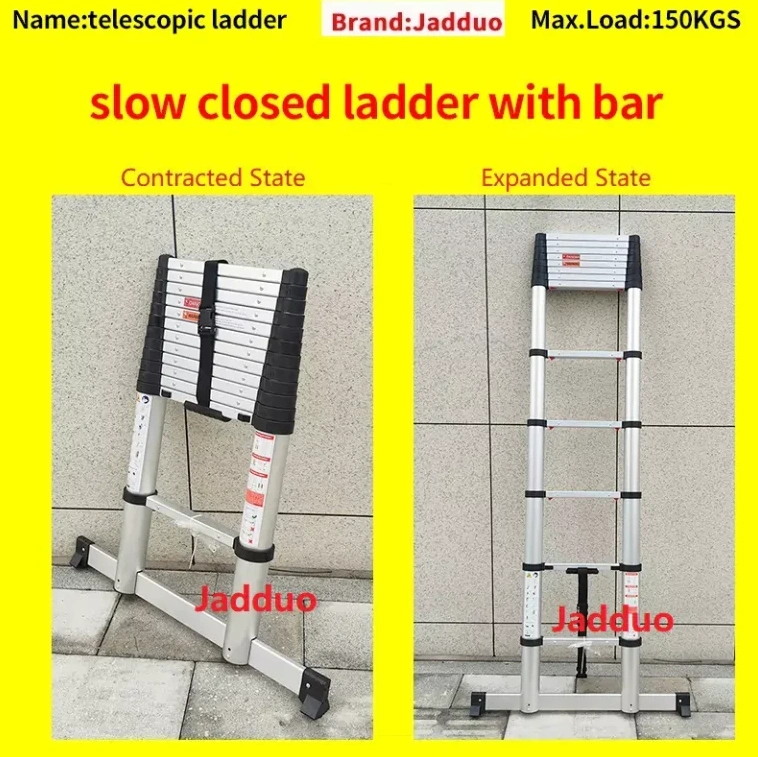
Setting up a ladder may appear like a task that anyone can handle without guidance, yet many incidents occur annually due to basic principles of physics. Whether someone is clearing debris from gutters or accessing a rooftop tent on a road trip, the manner in which the ladder rests against a wall or vehicle proves essential. Here, the established “4-to-1 Rule” serves as a fundamental safety guideline that ensures the climb remains secure.
Achieving the correct setup involves grasping how elevation and separation interact to form a firm foundation. Prior to selecting appropriate equipment from Jadduo’s lineup—a firm located in Yongkang, known as the “Hardware Capital,” which distributes more than 300,000 units each year—it proves useful to comprehend the calculations underlying the incline.
What Exactly Is the 4-to-1 Rule?
To begin, consider the 4-to-1 rule as a basic proportion for arrangement. It goes beyond mere guidelines from training sessions; rather, it offers a sensible method to prevent the ladder from falling back or slipping away beneath the user.
One Foot Out for Every Four Up
The guideline remains simple: for each four units of rise to the point where the ladder meets the support, position the bottom one unit distant from the upright face. Thus, if reaching a 12-unit high gutter, place the ladder’s base precisely three units from the wall. This proportion maintains the load balanced over the steps, rendering the entire assembly far more dependable during ascent.
On a work area, gauging this often avoids needing a measuring tool each time. Many experienced workers rely on their steps to estimate the gap or apply the “arm’s reach” method, where they position their toes near the ladder’s base and extend; if they can grasp the step at chest level with outstretched arms, it typically aligns closely.
Maintaining a 75-Degree Angle
Following that 4-to-1 proportion accurately produces a 75-degree slant between the surface and the ladder sides. This particular slant represents the ideal position for metal ladders. It delivers sufficient tilt for firmness while ensuring the steps stay even, so the user’s footing avoids a tilted sensation.
Jadduo crafts their adjustable and extending ladders to function optimally at this 75-degree position. Since these items employ superior aluminum that weighs considerably less than traditional timber—frequently 60% reduced—adhering to the proper slant avoids excessive bending under substantial pressure.
Quick Calculations for Real-World Jobs
In practical scenarios, elevations rarely match exact multiples like four or eight units. For an instance at 10 units high, set the base 2.5 units outward. It is preferable to position it a bit farther than nearer, as a near-vertical setup risks toppling when the user ascends near the peak.
Employing these rapid assessments yields significant benefits for activities such as installing seasonal decorations or trimming branches. Even for brief tasks lasting mere minutes, spending a moment to approximate the 4-to-1 proportion can avert serious injuries.
Why Is Proper Angle Alignment Crucial?
Grasping the reason for the guideline aids in consistently applying it. It extends past compliance for its own sake; instead, it concerns directing the effects of gravity and traction that constantly attempt to destabilize the ladder.
Stopping the Ladder From Sliding
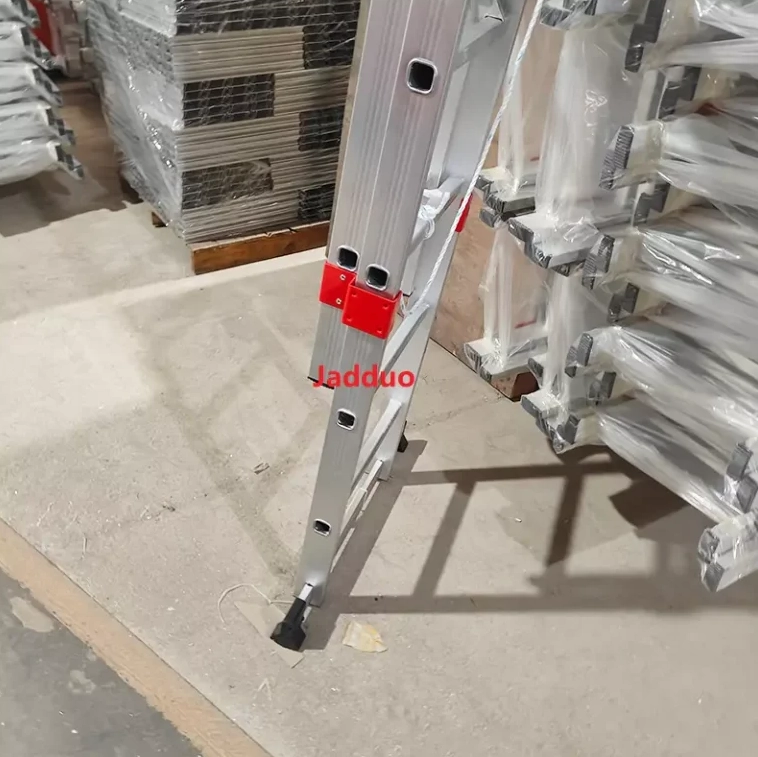
Should the ladder adopt a slant that is excessively gentle—indicating the base positioned too distant—gravity draws the bottom from the wall. Although superior rubber bases crafted to adhere to turf, dirt, or stones offer strong hold, friction has boundaries. At a 75-degree slant, the majority of the load directs downward into the earth, which in turn assists the bases in remaining fixed.
Jadduo’s ladders frequently incorporate unique “round rubber foot caps” tailored for varied grounds. Nevertheless, even the finest adhesion cannot overcome flawed mechanics if the slant deviates greatly. Thus, situating the base according to the one-to-four proportion minimizes the forward “thrust.”
Handling the Full Weight Capacity
Typical heavy-duty metal ladders support around 150kg, accommodating an average person along with tools or supplies. This capacity holds true only when the ladder stands correctly. With the appropriate slant, the load channels along the side bars as planned by the design team.
If the ladder lies too horizontal, it behaves more like a span than a prop. Consequently, this imposes heavy strain on the central sections of the bars, potentially causing deformation or vibration during use. For individuals transporting substantial materials for rooftop tasks, such instability proves highly undesirable.
Staying Steady at High Points
As the user rises higher, any instability at the foundation amplifies noticeably. Ignoring the 4-to-1 guideline may cause the upper portion to sway laterally or detach from the wall once the user’s balance shifts upward. This explains why regulations like EN131 mandate tests for varying loads to confirm the ladder retains rigidity.
For jobs involving gutter cleaning or tile fixes, the ladder must protrude at least three units beyond the roof line for secure entry. Absent the right base slant, that additional three-unit extension acts as a pivot, rendering the arrangement precarious the instant the user attempts to transfer to the roof.
Which Jadduo Extension Ladders Best Fit Your Needs?
Selecting the suitable implement for the task holds equal importance to the arrangement process. Jadduo provides various choices that simplify adherence to safety measures, ranging from everyday household versions to advanced configurations for expert applications.
Single-Sided Stick Step Ladder Aluminum
For individuals seeking a straightforward, reliable device for domestic fixes, the Single-sided Stick Step Ladder Aluminum stands out as a dependable option. It features a design that is slim and simple to relocate around the residence or garden. Given its direct-back form, it leans readily against a surface, allowing easy verification of the 4-to-1 proportion prior to tackling overhead tasks like ceiling repairs or fixture adjustments.
These ladders emerge from a 10,000-square-meter plant with rigorous inspections. They possess sufficient lightness that a single individual can manage the placement independently, which matters greatly when shifting positions around the property for lighting corrections or wall coatings.
Two-Section Ladder Precision with Pulley Systems
For elevated assignments, such as accessing upper-floor openings or lofty branches, the 2 Section Ladder With Pulley and Rope simplifies the process considerably. The integrated pulley mechanism enables elevation changes without dismantling and repositioning on the terrain. As a result, the user can establish the base at the 4-to-1 distance and then lengthen the upper segment to the precise requirement.
This rope and pulley arrangement greatly assists in group efforts or storage facility operations where heights vary often. It represents a specialist-level aid that spares the user physical effort in fine-tuning the stature.
Certified Reliability for Tough Jobs
Every one of these items includes the assurance of EN131 or ANSI approvals. Such validations confirm evaluations for elements like “anti-slip” markings and bearing limits. When positioned 15 units aloft, the knowledge that the ladder endured a 72-hour engineering assessment or possesses a functional patent for its structure boosts user assurance.
Production in Yongkang entails accurate tube slicing, forming, and fastening to ensure each connection remains secure. These are not hastily assembled; they constitute crafted instruments built to endure prolonged service across diverse settings.
How Does This Apply to Off-Road Camping?
The 4-to-1 guideline applies not only to building faces but also proves vital during outdoor setups for rest. Elevated sleeping platforms have gained popularity among vehicle owners, yet entry demands particular ladder precautions.
The 2X4 Extension Telescopic Tent Ladder
The 2X4 Extension Telescopic Tent Ladder suits the adventure seekers in remote travel. It compacts to less than one meter for storage in cargo areas or packs. Upon setup for overnight stays, it stretches to form a route to the upper tent.
Constructed from aviation-grade aluminum alloy, these weigh merely between 3kg and 6kg. That portability allows easy transport, while the strength supports an adult with bedding. In isolated spots, the 4-to-1 guideline persists; the base requires adequate distance from the automobile to secure the path.
Hook Design for Solid Vehicle Attachment
A standout aspect of Jadduo’s tent ladder series involves dedicated hooks. These secure onto the tent’s structure or the car’s roof system. Such fastening provides extra firmness that ordinary ladders lack. Should the terrain yield slightly and the base move, the hooks prevent lateral drift at the top.
Despite the hooks, preserving the 75-degree slant remains critical. A overly upright position strains the hooks excessively; a too-horizontal one exerts undue tug on the tent’s frame. Adhering to the 4-to-1 guideline balances the forces evenly.
Handling Uneven Ground in the Wild
Outdoor stays often involve turf, granules, or pebbles rather than smooth pavement. The “round rubber foot caps” on these ladders adapt to such irregular bases. This versatility proves essential for explorers venturing into harsh locales like arid zones or peaks, where conditions fluctuate from -20°C to 50°C.
For added firmness, certain versions offer a “balance bar” for the base. This extension broadens the footing and reduces sway on rough soil. It serves as a basic enhancement that notably improves steadiness following extended treks.
What Technical Specifications Enhance Product Durability?
Apart from the setup calculations, the ladder’s composition and construction significantly influence safety. An item that warps or corrodes eventually poses risks.
Aircraft-Grade Aluminum for Tough Environments
Jadduo employs “anodized aluminum” in most extending and adjustable models. This treatment goes beyond aesthetics; it forms a protective coating against moisture or saline exposure. For coastal residents or those using ladders for “Fire Escape” or urgent scenarios, this resilience is indispensable.
Incorporating 6063 or comparable robust aluminum keeps the items “lightweight” yet compliant with EN131-2:2025 criteria for load simulations. Consequently, the ladder avoids a yielding feel when occupied at upper levels.
Black Oxidation for Better Rust Protection
For those desiring greater toughness, Jadduo provides a Black Oxidation coating on select one-touch adjustable variants. This exceeds mere coating; it involves a reaction that heightens resistance to abrasions and weather effects. It appeals to factory settings or extended external applications where exposure lasts for extended periods.
This coating also supports “low-temperature adaptability,” preventing mechanism jams in sub-zero conditions down to -20°C. Such nuances distinguish expert equipment from inferior copies.
Widened Pedals for More Comfortable Climbing
A frequent issue with adjustable ladders concerns narrow steps that discomfort feet over time. Jadduo addresses this through designs featuring 6cm widened steps. These broader platforms expand the “force area,” distributing the user’s load across more of the sole.
This renders the ladder considerably “stable and secure” for precise activities like surface treatments or edge maintenance. Paired with the ridged “anti-slip” pattern on steps, it ensures safer footing in damp or frosty weather.
FAQ
Q1: Can I use the 4-to-1 rule on a step ladder?
A: No, the 4-to-1 rule applies particularly to extension and telescoping ladders that “lean” against a surface. Step ladders (A-frame) support themselves and must be fully extended with braces secured.
Q2: What if the ground is too soft to maintain the 75-degree angle?
A: If the surface yields, such as in mud or loose granules, the bases may embed. In such situations, place a broad, flat, gripping panel beneath the bases to form a stable platform, then verify the 4-to-1 proportion again.
Q3: Does the weight of the ladder (3-6kg) affect its stability?
A: Although the ladders prioritize portability through light construction, their firmness derives from the alloy’s durability and the rubber foot caps. Provided the 4-to-1 rule guides placement and the load stays below 150kg, the reduced mass does not impair safety.