Positioning a ladder may appear as a straightforward chore, but the principles of physics related to its inclination can determine whether safety holds or fails. You could be ascending to your rooftop tent for a brief getaway in the hills, or removing debris from rain channels, and in each case, the ladder’s inclination serves as the key element in the arrangement. An error here invites the primary concerns with ladders: the bottom shifting away beneath you, or the upper part falling back as you reach the middle.
Located in the “Hardware Capital” of Yongkang, Jadduo has produced high-quality ladders since 2015. With a production volume of 30,000 units each month and shipments to more than 50 countries, the firm recognizes that protection goes beyond mere markings—it concerns how the tools manage actual field conditions.
Why Is the 75-Degree Angle the Gold Standard for Safety?
Experienced users rely on the 75-degree angle since it achieves the ideal level of steadiness. This figure arises not from chance; rather, it represents the equilibrium where a person’s mass presses the ladder firmly against the surface instead of forcing it apart from the support. Without a measuring device at hand, apply the “1-in-4 rule”: for each four units of vertical distance required, position the ladder’s base one unit distant from the upright structure.
Optimal Balance Between Friction and Stability
At 75 degrees, the grip between the base and the earth reaches its peak effectiveness. Should the inclination prove too low—under 75 degrees—the ladder essentially risks gliding outward, much like an individual attempting a wide stance. Jadduo’s models, which bear a typical 150kg capacity, receive engineering to cope with this pressing force, ensuring the feet remain stationary without any movement.
Prevention of Structural Stress and Flexing
Ladders receive construction to support loads straight through the side members. When the inclination deviates, the central portion begins to vibrate or bend beneath the user’s mass, creating a hazardous condition. By adhering to the proper angle, one guarantees that the aluminum or fiberglass maintains its firmness, aligning with the stringent EN131 and ANSI protection criteria that Jadduo observes for every exported item.
Maximum Efficiency of Anti-Slip Features
Contemporary ladders, particularly those from Jadduo, incorporate dedicated rubber bases and ridged steps. When tilted at 75 degrees, these steps align evenly beneath footwear. As a result, even during light precipitation or with soil on the shoes, the design offers the greatest contact area for secure footing.
Moving from broad protection guidelines to particular equipment, consider how these principles function in outdoor settings. For individuals embracing mobile adventures, the ladder does not rest against a firm masonry barrier—instead, it leans on the vehicle itself.
Which Ladder Is Best for Rooftop Camping and RV Travel?
Rooftop tents (RTTs) have revolutionized outdoor stays, yet they position high on sport utility vehicles or truck platforms. Such setups demand a ladder that extends sufficiently to access, while remaining compact enough to store without occupying excessive space for other items. Here, specialized extendable structures prove particularly useful.
The 2X4 Extension Telescopic Tent Ladder
The 2X4 Extension Telescopic Tent Ladder gains popularity among campers due to its suitability for travel. It generally extends from 2.0m to 2.6m based on user requirements, fitting most vehicle configurations ideally. Once the evening concludes, it retracts to below one meter, allowing easy placement in storage areas like a vehicle’s rear or attached pouch.
Aerospace-Grade Durability with Lightweight Portability
Constructed from treated aluminum—the material employed in aircraft—this ladder weighs merely 3-6kg, offering superior ease compared to transporting cumbersome traditional wooden versions that lack collapsibility. Moreover, the “Black Oxidation” coating provides more than visual appeal; it safeguards the alloy from coastal moisture and upland showers, preventing stiffness or decay after a single period of use.
Specialized Design for Unstable Terrain
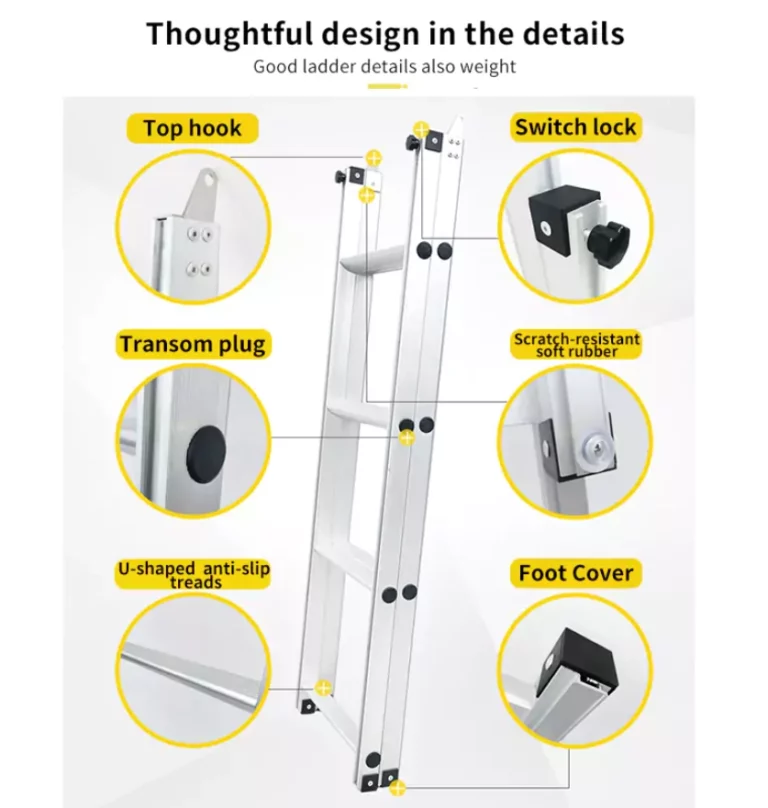
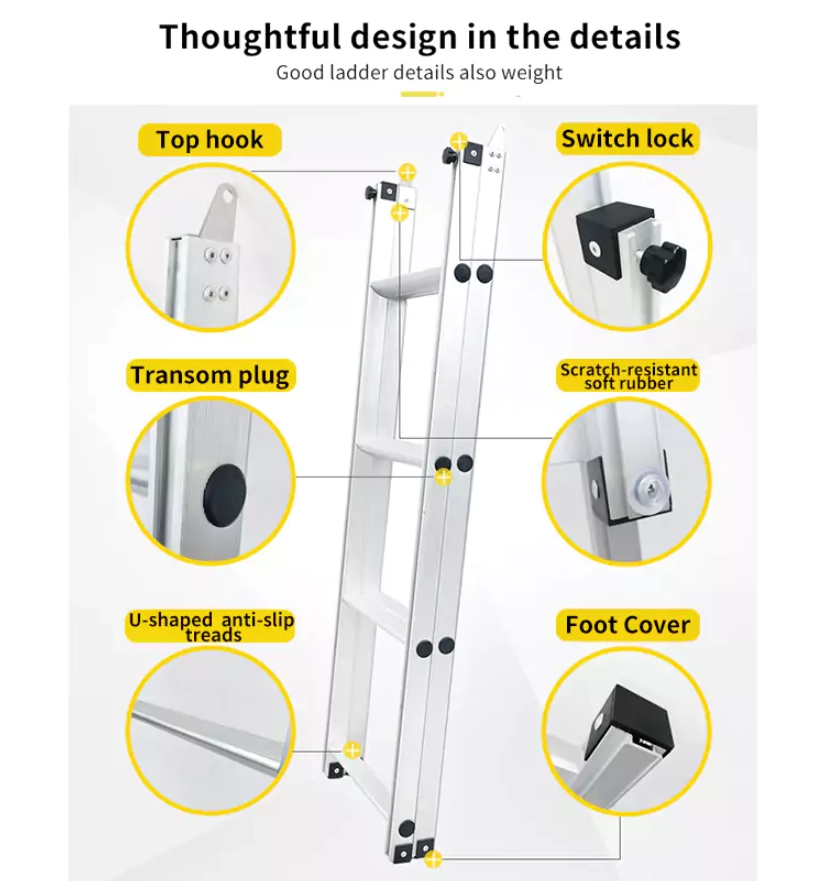
Outdoor activities seldom occur on smooth paved surfaces. Jadduo’s tent ladders feature an innovative attachment method to secure onto the tent structure, ensuring the upper end holds position reliably. At the lower section, the circular rubber supports dig into turf, loose soil, or pebbles, maintaining the 75-degree inclination steadily despite uncertain ground conditions.
Although camping emphasizes relaxation, certain tasks carry elevated risks. When work involves proximity to electrical lines or demands a self-supporting ladder, a distinct type of equipment becomes necessary.
How Do Professionals Handle High-Voltage or Complex Environments?
Within industrial applications, aluminum may not serve as the ideal choice. If any possibility exists of contacting energized conductors, an insulated variant is essential. Fiberglass emerges as the preferred substance in these scenarios because it resists electrical flow, thereby providing safe grounding.
Red Insulated Multi-Functional Ladder with Big Hinge
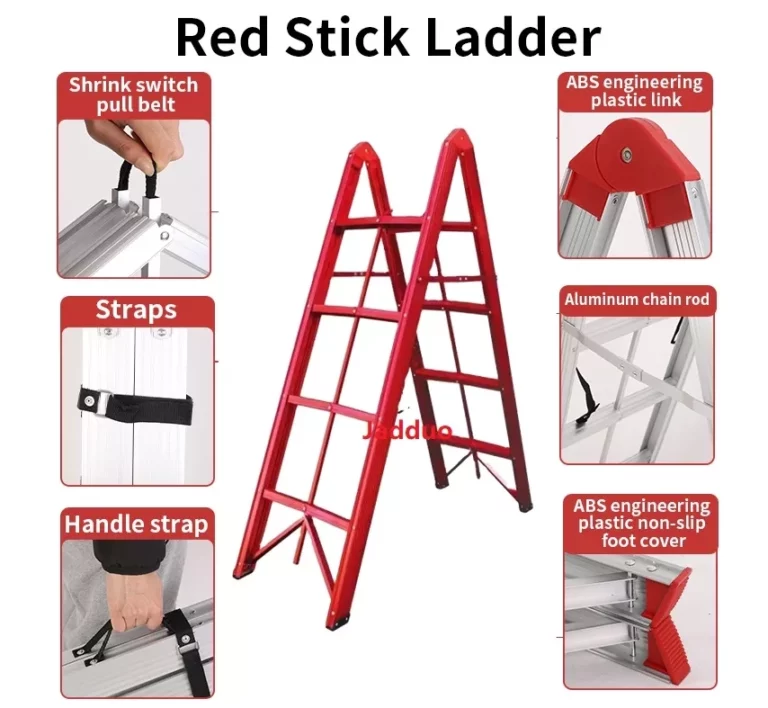
The Red Insulated Multi-Functional Ladder functions like a versatile tool in the ladder category. Owing to its “big hinge” configuration, users can deploy it as a basic triangular ladder for interior coating tasks or extend it fully for exterior fixes. It accommodates 150kg, rendering it robust for skilled tradespeople along with their substantial equipment carriers.
Enhanced Stability for Heavy-Duty Applications
This variant depends not solely on fiberglass; reinforcements ensure it avoids the irritating sway common in low-cost options. Whether trimming branches in landscapes or operating in storage facilities, the framework preserves its solidity. The broad steps further enhance comfort during prolonged standing periods exceeding a few minutes.
Adaptive Safety Locks and Balance Bars
The “Big Hinge” serves a practical purpose beyond appearance—it constitutes a sturdy securing device that engages firmly, confirming the ladder’s stability. For added protection, these units frequently include a stabilizing bar at the base. This element expands the support area, significantly reducing the likelihood of lateral overturn if reaching slightly to one side or the other becomes necessary.
Occasionally, a versatile device suffices not; instead, ascending to considerable heights requires focus. When a standard hinged ladder falls short of the eaves, deploying extended models becomes imperative.
How Can You Simplify High-Altitude Maintenance and Rescue?
Addressing multi-level residences or vast storage buildings demands elevation without excessive mass. In such instances, a two-part extendable ladder emerges as a valuable asset, particularly when equipped with practical enhancements for positioning.
Red Insulated 2-Section Ladder with Pulley and Rope
The Red Insulated 2-Section Ladder with Pulley and Rope suits demanding operations. It incorporates a pulley and cord mechanism, eliminating the need to lift the substantial upper portion by hand. Simply drawing the cord raises the ladder to the desired level. Being fiberglass-insulated, it stands as the preferred selection for communication technicians and emergency responders who must avoid electrical hazards.
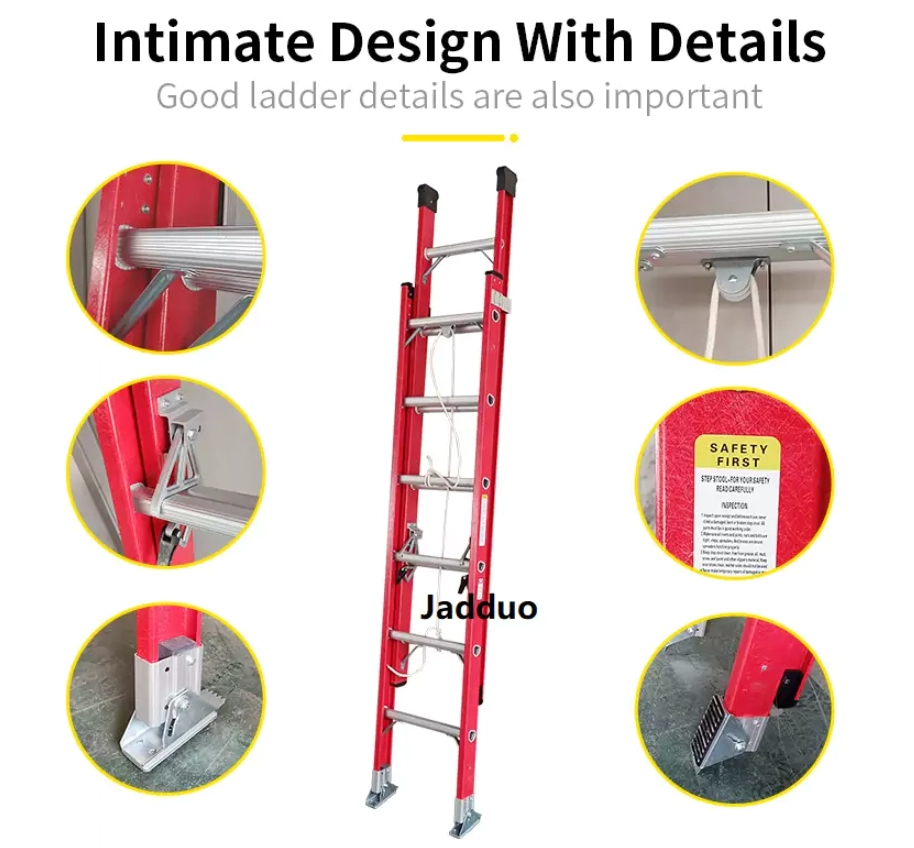
Mobility Features for Rapid Deployment
In truth, large ladders pose challenges in transport. For this reason, Jadduo integrates base wheels into these designs. Users can incline the ladder and maneuver it to new locations by rolling, rather than bearing it on the back. This minor addition substantially eases efforts when addressing perimeter maintenance on expansive structures.
Compliance with Global Safety Certifications
Each Jadduo ladder undergoes a thorough manufacturing sequence—from accurate tube forming and perforation to complete integration in a 10,000㎡ facility. These two-section ladders conform to the recent EN131:2025 revisions, which now enforce stricter non-slip markings and capacity evaluations. While positioned 20 feet above ground, the assurance of ISO9001 certification instills additional trust to complete the task effectively.
FAQ
Q1: Can I use an aluminum ladder for electrical work if I’m careful?
A: No, it’s just not worth the risk. Aluminum is a great conductor of electricity. Even if you aren’t touching a wire directly, an arc can jump to the metal. Always use a fiberglass (insulated) ladder for anything near power lines or electrical boxes.
Q2: How do I know if my ladder is at exactly 75 degrees?
A: You don’t need a math degree for this. Use the “elbow trick”: stand with your toes touching the ladder’s feet and reach your arms straight out. If your palms touch the rung in front of you comfortably, you’re pretty much at 75 degrees. If you have to lean forward or reach back, adjust the base.
Q3: What is the weight limit for a Jadduo telescopic ladder?
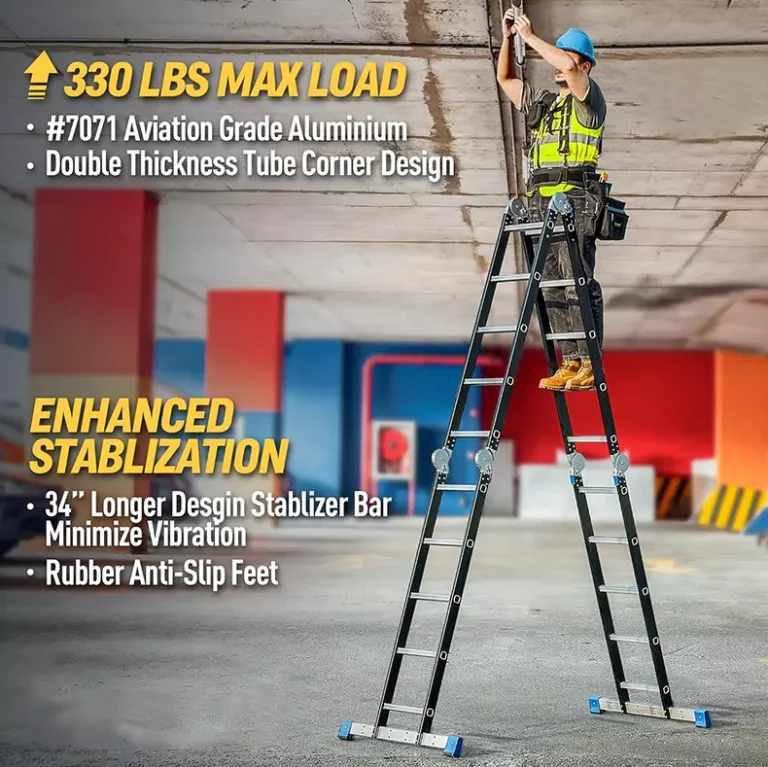
A: Most of our standard telescopic and multi-purpose ladders are rated for 150kg (about 330 lbs). This includes the weight of the person plus any tools, paint cans, or camping gear they are carrying. Always check the specific rating on your ladder’s safety label before climbing.