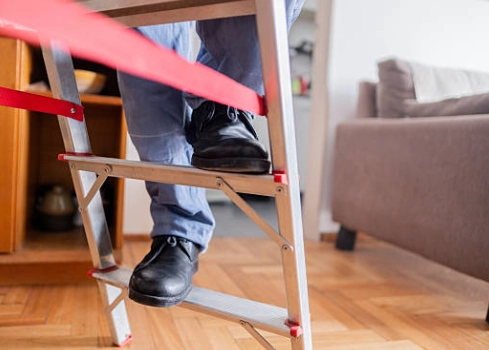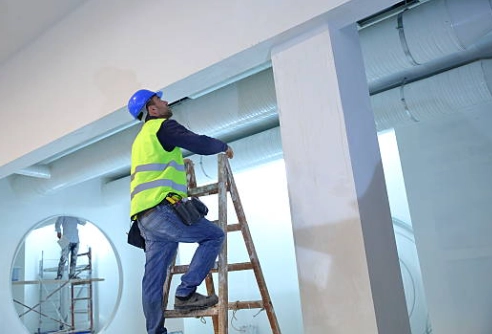
Setting the correct placement angle for an extension ladder is a primary safety requirement on any job site. The golden rule established by safety codes mandates an angle of 75.5 degrees from the horizontal, which corresponds to 15 degrees from the vertical. To achieve this quickly in the field, operators rely on the 4-to-1 distance ratio. Failing to position climbing equipment at this precise angle creates immediate physical hazards, including base sliding or backward tipping. For contractors, safety inspectors, and procurement managers, establishing consistent setup protocols prevents workforce injuries and expensive structural liabilities on commercial projects.
As an industrial manufacturer operating since 2015, Jadduo specializes in engineering heavy-duty climbing equipment and scaffolding platforms designed for strict commercial environments. By maintaining direct control over extrusion metallurgy, wall thickness tolerances, and mechanical assembly, the factory provides contractors and distributors with hardware built to pass stringent European EN131 testing protocols.
![What Is the Correct Placement Angle for an Extension Ladder [75° Rule & Safety Checklist]](https://www.jadduo.cn/wp-content/uploads/2026/08/What-Is-the-Correct-Placement-Angle-for-an-Extension-Ladder-75°-Rule-Safety-Checklist.webp)
Why Is the 75-Degree Placement Angle Essential for Extension Ladder Safety?
Positioning climbing equipment requires an understanding of physics, friction dynamics, and structural load pathways. The angle at which the rails meet the ground determines how downward worker weight translates into ground grip and wall support.
Optimal Load Distribution at the 75-Degree Angle
Maintaining a 75.5° angle from horizontal provides the mathematically proven equilibrium between base grip and rail rigidity. When a worker climbs an extension ladder pitched at this inclination, approximately 15° proper angle degrees from vertical, downward force drives the slip-resistant feet into the surface. This mechanical balance ensures the structure remains stable while keeping the center of gravity within a safe vertical corridor. Safety standards, including EN 131 ladder standard angle 75 degrees requirements, rely on this geometry to ensure uniform load distribution across every rung.
Friction Loss and Base Slip Hazards at Shallow Angles
Setting the pitch angle below 70° causes a rapid shift in horizontal force vectors. At shallow pitches, the horizontal thrust pushing outward against the base exceeds the static friction coefficient between the feet and the flooring material. This imbalance leads to base slip at a shallow angle, causing the footings to slide out without warning under heavy load. Contractors face severe liability when equipment shifts outward due to insufficient pitch angles.
Structural Overload and Tipping Risks at Steep Angles
Conversely, positioning the rails at an angle steeper than 80° creates a top-heavy condition. When pitched nearly vertical, the equipment loses its firm resting contact against the supporting wall. As a worker carries materials or reaches sideways, the center of gravity shifts outward beyond the base footings. This condition increases the likelihood of the structure tipping backward or sideways, while subjecting the top rung assemblies to concentrated point loads.
How Can You Calculate and Verify the Correct Placement Angle on Job Sites?
Field crews rarely carry protractors or angle indicators to high-reach tasks. Practical measurement methods allow operators to verify proper pitch within seconds before stepping onto the rungs.
Application of the Standard 4-to-1 Distance Ratio
The simplest mathematical method for job-site compliance is the 4 to 1 extension ladder angle ratio. To calculate the correct base distance, divide the vertical height from the ground to the upper resting point by four. For instance, if the top resting point against a wall measures 16 feet high, the base footings must sit exactly 4 feet away from the wall. This 1:4 proportional spacing automatically establishes the correct angle of inclination for single and extension ladders without complex geometry.
Quick Arm-Reach Field Test for Site Workers
For on-site verification without measuring tapes, workers can execute the standard arm-reach test. The operator stands upright at the base with toes touching the bottom rubber footings. Extending both arms straight forward at shoulder height, the palms should rest comfortably on the rung directly ahead. If the palms fall short or require leaning forward, the base sits too far out; if elbows must bend, the pitch remains excessively steep.
Step-by-Step Extension and Lock Engagement Verification
Calculating the slope ratio forms only part of the setup protocol. Before climbing, workers must execute a three-point physical check: verify that the base rests on firm, level ground; confirm that both gravity-fed rung locks fully engage over the supporting rungs; and ensure the top guide brackets align cleanly against the vertical support structure.
What Key Features Should You Check When Sourcing Industrial Extension Ladders?
Procurement engineers evaluating equipment for commercial fleets must look beyond surface dimensions. Assessing raw alloy grades, internal wall thickness, and certified duty limits prevents premature equipment failure on demanding job sites.
International Safety Compliance and Load Ratings
Commercial construction demands hardware rated for single-person working capacities of 150kg, including user weight and tool kits. European EN131 certification mandates stringent side-rail deflection tests, rung strength verification, and dynamic base slip resistance. Sourcing equipment verified against official testing standards ensures that every unit maintains structural integrity during high-reach tasks.
High-Grade Aluminum Alloys and Electrical Insulation Materials
Material selection determines how rails respond to torsional stress and environmental exposure. Heavy-duty aluminum units utilize 6063-T5 aluminum alloy, featuring main wall thickness profiles between 1.2mm and 1.5mm to eliminate rung flex under load. For utility electrical maintenance, non-conductive fiberglass side rails replace metal frames to insulate operators against live current hazards.
Mechanical Pulley Systems and Wear-Resistant Accessories
High-reach operations benefit from integrated rope-and-pulley mechanics, which allow operators to extend upper sections smoothly without manual lifting strain. Key structural wear points—such as heavy-duty steel hinge locks—must undergo 10,000-cycle fatigue testing. Additional accessories, including wide stabilizer bars and heavy rubber footings, maintain ground traction across wet or uneven surfaces.
Which Jadduo Extension Ladders Best Fit Your Commercial Worksite Needs?
Matching specific job site conditions with the appropriate frame style ensures both worker safety and long-term operational efficiency. Sourcing directly from specialized manufacturers allows commercial buyers to align technical specifications with exact project demands.
Jadduo Red Insulated 2-Section Ladder with Pulley and Rope for Electrical Work
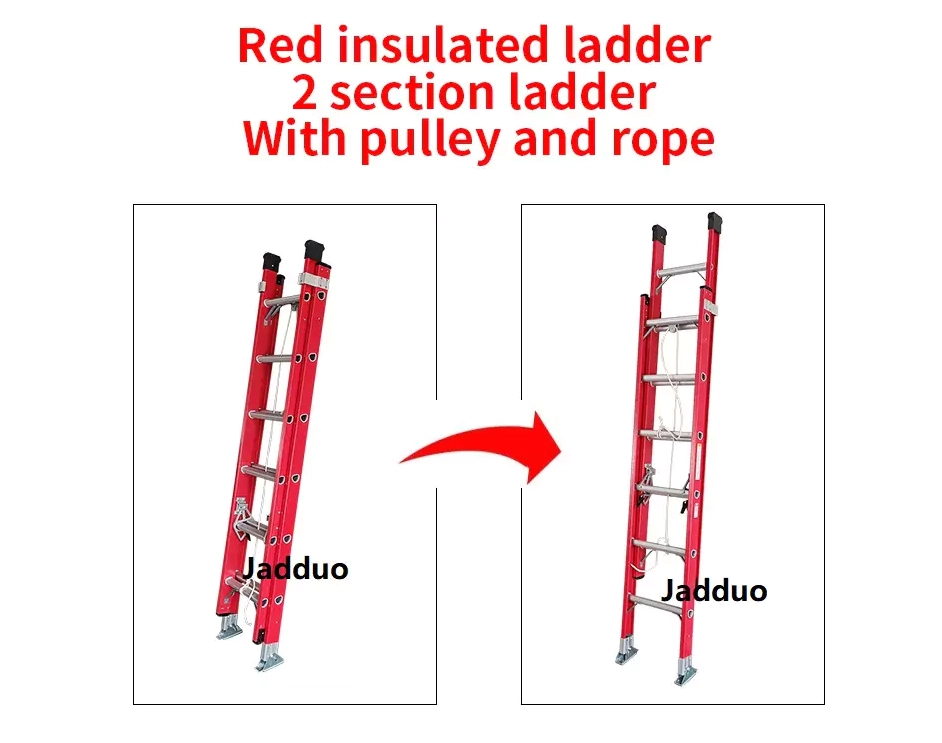
Power utility crews and electrical contractors require non-conductive framing combined with reliable extension mechanisms. The Red insulated ladder 2 section ladder With pulley and rope combines high-dielectric fiberglass side rails with a 150kg load capacity. Its integrated pulley mechanism allows smooth single-operator adjustment on site, while deep-grooved anti-slip rungs maintain footing security during electrical line inspections.
Jadduo 2-Section Ladder with Pulley and Rope for High-Reach Engineering
For exterior building maintenance, painting, and masonry repairs, structural rigidity and low weight are critical. The 2 Section Ladder With Pulley and Rope uses 6063-T5 aluminum alloy profiles with optimized wall thickness to deliver a strong 150kg rated platform. Equipped with smooth rope-and-pulley hardware and heavy-duty locking pawls, it provides quick deployment for exterior engineering tasks.
In-Depth Practical Field Safety and Placement Reference Guide
Building a comprehensive equipment safety protocol requires integrating proper positioning rules with daily inspection routines. Site managers seeking detailed guidelines on slope metrics, site hazard management, and worker protocols can read our complete guide on What Is the Correct Angle for an Extension Ladder? A Practical Safety Guide for further field safety insights.
How Does Jadduo Support B2B Buyers with Custom Services and Sourcing?
Commercial equipment buyers require reliable manufacturing partnerships that offer product consistency, custom modifications, and reliable long-term component availability.
OEM Custom Manufacturing and Rigorous B2B Quality Control
With dedicated production experience established since 2015, manufacturing processes include 100% factory inspection of structural welds, rail thickness, and lock engagement. B2B clients can request OEM custom height configurations, specialized rail coatings, and private branding options tailored to specific fleet requirements.
Reliable Spare Parts Supply and After-Sales Support
Long service lifespans depend on easy access to replacement wear components. Maintaining stock of replaceable anti-slip rubber feet, stabilizer bar assemblies, pulley ropes, and hinge lock hardware allows fleet managers to repair minor wear without retiring entire units, significantly lowering long-term operating costs.
Direct Inquiry and Consultation for Bulk Commercial Orders
Procurement managers and equipment distributors can coordinate directly with factory engineers to evaluate technical drawings, request load test documentation, or arrange volume shipping schedules tailored to project timelines.
Selecting the right climbing hardware for large fleet procurement or specialized industrial projects involves evaluating specific wall thickness tolerances, load ratings, and working heights. If your team requires technical parameter sheets, custom OEM configurations, or volume shipping details for upcoming commercial contracts, please contact our engineering support team to discuss your project requirements.
FAQ
Q: How do I calculate the 4-to-1 rule for setting up an extension ladder?
A: To calculate the base distance using the 4-to-1 rule, measure the vertical height from the ground to the top resting point of your extension ladder and divide that number by four. For example, if the top of the rails rests at 20 feet against a wall, place the base footings 5 feet away from the wall to achieve the standard 75.5-degree angle.
Q: What happens if the pitch angle of an extension ladder is set too shallow?
A: Setting an extension ladder at a shallow angle increases horizontal forces at the bottom. This reduces the footings’ grip on the surface and leads to severe base slip risks under load.
Q: What standard load capacity should commercial extension ladders support?
A: Industrial climbing equipment certified under standards such as EN131 must support a minimum working load capacity of 150kg, accounting for the combined weight of the worker and their tools.