Choosing a ladder for uneven ground starts with the site, not the ladder catalogue. Gravel, grass, compacted soil, slopes, stairs, and irregular floors create different stability problems. You need to assess whether the surface is firm, which ladder configuration fits the task, how high the user must work, and the combined load of the user and equipment. Transport and storage also matter for mobile teams. Rather than using blocks or loose packing to level a standard ladder, select a purpose-built design and follow the approved setup method. Jadduo offers several telescopic configurations suited to these purchasing criteria.
What Ground And Task Conditions Should Buyers Assess First?
A clear site assessment helps you avoid buying one ladder configuration for conditions that require several different access solutions.
Identify the Surface and Its Stability
Separate firm but irregular ground from ground that may move, sink, or become slippery. Compacted gravel may support a ladder while still creating uneven contact points. Loose gravel can shift. Grass may conceal soft soil, holes, roots, or debris. Sloped concrete is structurally firm but changes the foot angle.
An adaptive foot can improve contact with a supporting surface. It cannot make saturated soil, loose fill, or weak flooring structurally sound.
Define the Access Task and Ladder Configuration
Decide whether the job needs leaning access, a freestanding A-frame, or a staircase-compatible arrangement. Check the available upper support, access direction, work duration, tools carried, and frequency of repositioning.
Match the configuration to the site. Never compensate for unsuitable geometry with bricks, timber offcuts, loose packing, or unapproved attachments. If the ladder cannot be positioned as designed, choose another model or access method.
Calculate the Required Height and Total Load
Ladder length is not the same as working height. Determine the access point and the position from which the task can be completed without overreaching.
Calculate the total load from the user, clothing, tools, and carried materials. Check dimensions and permitted load by exact item number. Do not apply one model’s specification to every product in the same range.
Which Ladder Design Best Matches the Worksite?
The right ladder for uneven ground depends on whether you need adaptive foot contact, reinforced pole support, or independently adjustable legs.
Use Adaptive Feet for Leaning Access on Irregular Surfaces
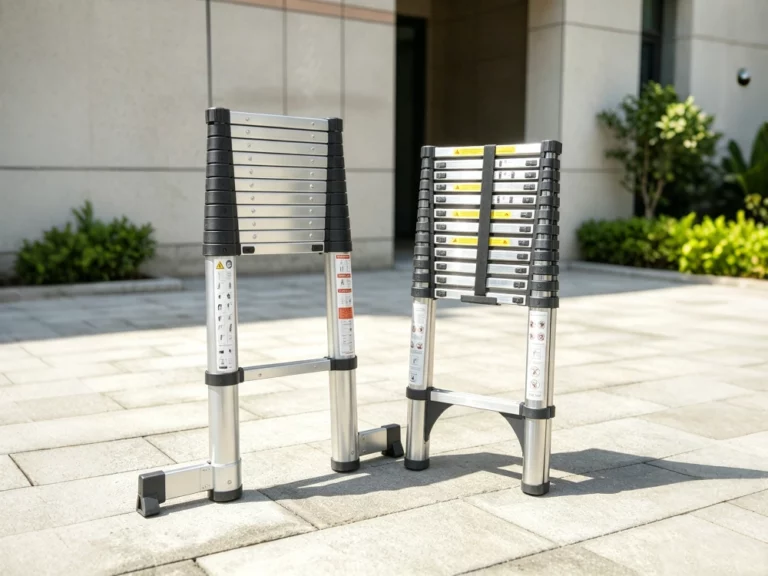
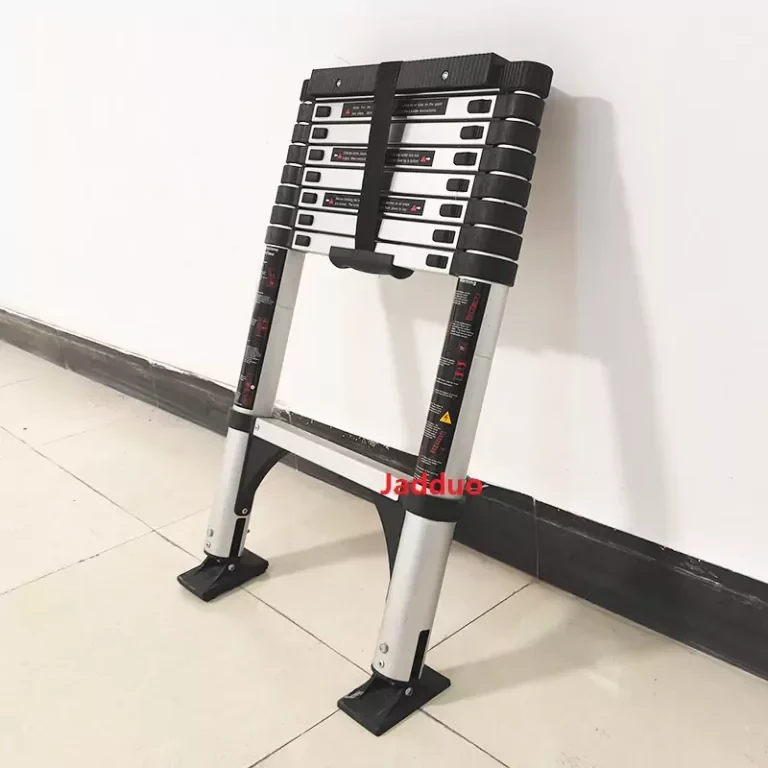
The One-key telescopic ladder with bottom movable foot top reliable telegraph pole has a foot designed to pivot through 360° and adapt to grass, gravel, stairs, and slopes. Its design targets full ground contact while keeping the ladder near a 70-degree stable angle. Actual suitability still depends on surface strength and correct placement.
JDT1020-ONE-DXGKJ-LEG is 2.0m long, closes to 68cm, weighs 4.8kgs, has seven steps, and carries a 150kgs maximum load. JDT1026-ONE-DXGKJ-LEG is 2.6m long, closes to 74.5cm, weighs 6.6kgs, has nine steps, and also carries a 150kgs maximum load. Both use aviation aluminum alloy construction, compact telescopic storage, and one-key retraction.
Consider Reinforced Pole Support for Repeated Industrial Access
The Stable Foot&Reinforced Bracket Pole Telescopic Ladder combines an adaptive stable foot with a reinforced bracket. It is an option to assess for repeated pole-style access where transportability and additional support are procurement priorities. The foot is designed for full surface contact, but buyers must confirm its suitability for the actual ground.
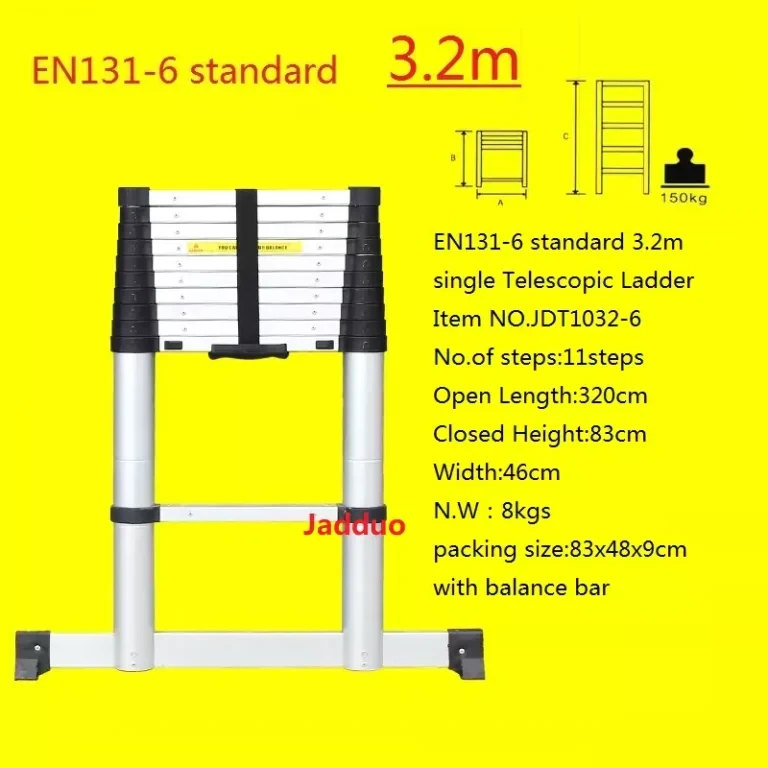
JDT1026-PStable foot opens to 2.6m, closes to 74.5cm, weighs 7.2kgs, has nine steps, and is rated for 150kgs. JDT1029-PStable foot opens to 2.9m, closes to 78.5cm, weighs 8kgs, has ten steps, and is rated for 150kgs. JDT1032-PStable foot opens to 3.2m, closes to 81cm, and weighs 9kgs.
Choose Independently Adjustable Legs for Stairs and Split-Level Areas
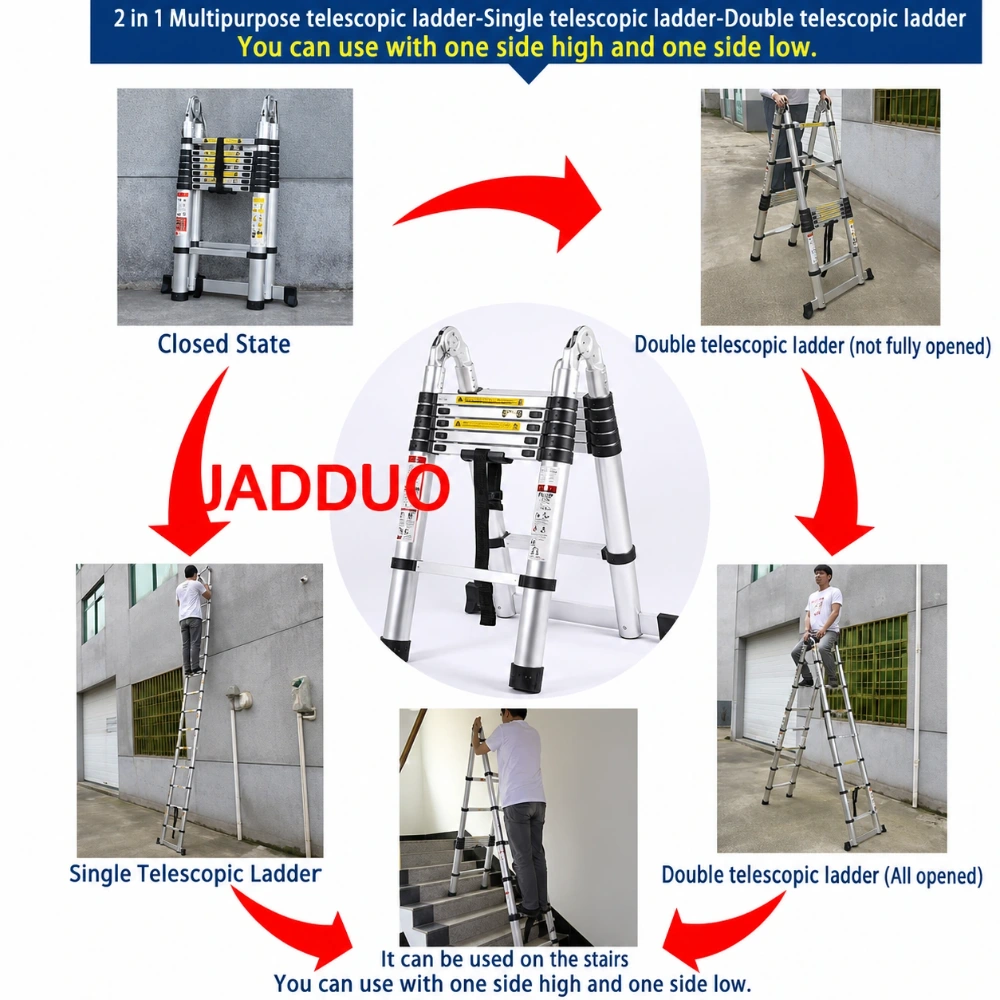
The Aluminum 2 IN 1 Multipurpose Telescopic Ladder Portable A Frame Ladders can operate as a leaning telescopic ladder or an A-shaped ladder. Separately adjustable leg lengths support positioning on stairs and split-level areas. Each leg must be correctly positioned and locked before climbing.
JDT3032 measures 3.2m(1.6m+1.6m), closes to 81cm, weighs 13kgs, has 5+5 steps, and carries 150kgs. JDT3038 measures 3.8m(1.9m+1.9m), closes to 84cm, weighs 15kgs, has 6+6 steps, and carries 150kgs. JDT3044 measures 4.4m (2.2m+2.2m), closes to 87cm, weighs 17kgs, has 7+7 steps, and carries 150kgs.
Which Specifications Matter Most in B2B Procurement?
A B2B comparison should connect every specification to the intended site, transport method, user group, and purchasing volume.
Compare Working Configuration, Length, and Footprint
Do not simply buy the longest ladder for uneven ground. Compare leaning, A-frame, and staircase-compatible configurations first. Then check open length, closed size, ladder width, step count, and the space required for correct placement.
Avoid calculating safe reach from ladder length unless that figure is approved for the exact model and configuration.
Verify Load Rating and Model-Level Data
Confirm the maximum load for each item number. A 150kgs rating applies only where that value is specified for the selected variant; it should not be assumed for another size with no listed rating.
Before ordering, request the current technical data, operating instructions, configuration details, and quotation for every item number. This reduces specification errors during bulk procurement.
Evaluate Portability, Storage, and Fleet Requirements
Closed size and gross weight affect vehicle storage, manual handling, and movement between sites. Compact telescopic models may suit maintenance fleets, distributors, and teams serving several locations, while heavier A-frame models may require different handling plans.
Build a procurement matrix covering item number, configuration, length, closed size, weight, load, site type, order quantity, packing needs, and replacement-part requirements.
How Should Industrial Teams Inspect and Use the Selected Ladder?
Product selection must be supported by consistent inspection, setup, training, and maintenance procedures throughout the ladder’s service life.
Complete a Documented Pre-Use Inspection
Before each use, inspect rails, rungs, steps, feet, brackets, hinges, locks, and telescopic sections. Look for deformation, missing parts, contamination, wear, or incomplete engagement.
Check that adaptive feet move correctly and retain their contact surfaces. Remove the ladder from service if its condition or locking action is uncertain, and record the inspection under your authorized procedure.
Prepare the Ground and Confirm the Setup
Clear loose debris and check that the ground can support the ladder, user, tools, and materials. Confirm full foot contact, correct orientation, engaged locks, and suitable upper support for a leaning ladder.
Reassess the setup whenever the ladder is moved or surface conditions change. Movable feet and adjustable legs help manage uneven geometry; they do not replace ground assessment.
Plan Maintenance, Training, and Replacement
Clean telescopic and moving components using the approved method. Do not drill, weld, extend, or modify the ladder with unapproved parts. Keep item numbers, inspection records, operating instructions, and replacement decisions traceable.
Train users on the purchased configuration, including leg adjustment, lock engagement, retraction, carrying, storage, and site-specific restrictions.
For help selecting a ladder for uneven ground, use Jadduo’s industrial ladder enquiry channel and provide the ground type, required configuration, access height, expected total load, item quantity, and transport requirements.
FAQ
Can a Telescopic Ladder Be Used on Gravel or Sloped Ground?
A telescopic ladder may be suitable when the ground is firm enough to support the full load and the feet can achieve stable contact. Adaptive feet can accommodate irregular geometry, but loose, shifting, wet, or compressible ground should be corrected or avoided before use.
Are Adjustable Ladder Legs Better Than Movable Feet for Stairs?
Independently adjustable legs are generally more appropriate when opposite sides of the ladder must stand at different heights, such as on stairs. Movable feet are intended to improve contact angle on irregular supporting surfaces. The correct choice depends on the ladder configuration and site geometry.
What Information Should a Buyer Provide When Requesting a Ladder for Uneven Ground?
Provide the surface type, leaning or freestanding configuration, required length, access point, expected total load, repositioning frequency, closed-size limit, preferred transport method, order quantity, destination, and required documents. Include site photographs or measurements when the ground geometry is complex.