Ladder safety does not end when the user reaches the required height. The working position introduces a different set of risks: balance, overreaching, tool handling, unstable support, incorrect standing level, and rushed descent. A safe setup must therefore match the complete task rather than height alone.
For U.S. workplaces, OSHA 29 CFR 1910.23 provides specific requirements for ladder inspection, loading, climbing, stable placement, and removal of defective ladders. For construction work, OSHA 29 CFR 1926.1053 adds requirements such as the approximately 4:1 setup rule for non-self-supporting ladders. For European-market procurement, EN 131-2 covers general requirements, testing, and marking for portable ladders, with additional parts applying to particular ladder types. These standards should be checked against the exact product, market, and task rather than used as a generic compliance claim.
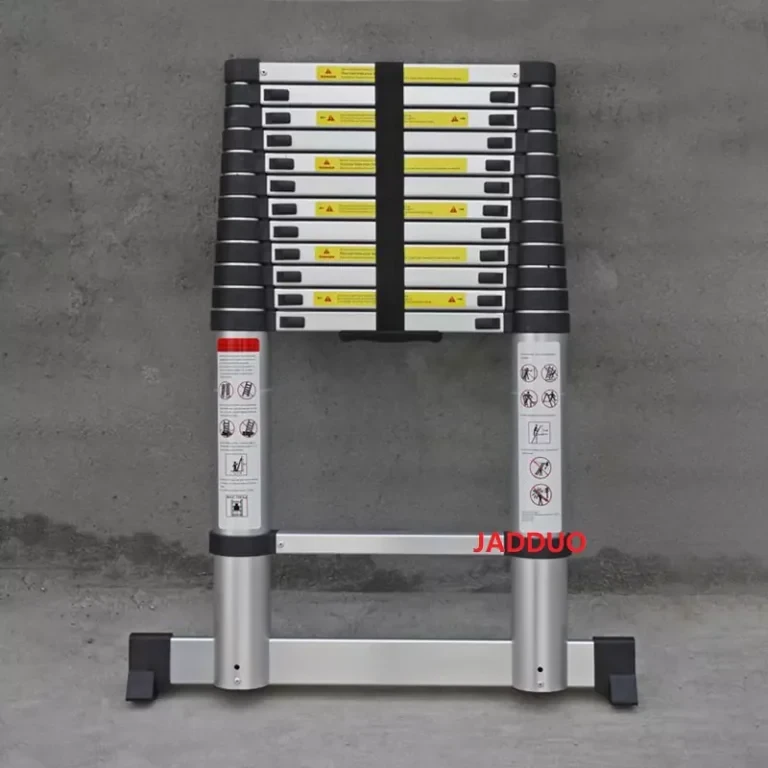
Jadduo supplies step, A-frame, telescopic, platform, and other ladder configurations for different access needs. Product dimensions and published load figures are useful for comparison, but they do not by themselves prove that a model is suitable for a particular professional, industrial, or regulated application. Buyers should verify the exact model documentation before specifying it for repeated workplace use.
Why Does Ladder Risk Continue at the Working Position?
Reaching the work area changes the task from climbing to positioning, handling tools, applying force, and moving the upper body. A ladder that felt stable during ascent can become unsuitable if the user must lean sideways, twist repeatedly, carry an awkward object, or work beyond the ladder’s intended standing level.
Confirm Stability and Locking Before Starting Work
Before beginning the task, confirm that the feet remain firmly seated, the support surface has not shifted, and all applicable spreaders, hinges, locks, hooks, or stabilizing parts remain fully engaged. OSHA 1910.23(c)(4) requires portable ladders to be used on stable and level surfaces unless they are secured or stabilized against accidental displacement. OSHA 1910.23(c)(6) also prohibits moving, shifting, or extending a ladder while an employee is on it.
If the position feels unstable, the support is contaminated, or the work cannot be completed without excessive reaching, the correct response is to descend and reset the ladder. Repositioning is part of safe workflow planning, not wasted time.
Use Three-Point Contact While Climbing, Then Work From a Controlled Position
OSHA 1910.23(b)(12) requires at least one hand to grasp the ladder while climbing up or down. OSHA has explained that the intent of this requirement is to maintain three points of control during climbing. That principle should not be misread as permission to perform any task from any rung: once at the working position, the user still needs a stable body position, suitable hand support where the task allows, and a ladder configuration designed for the work.
Tools should not force the user to abandon safe climbing technique. OSHA 1910.23(b)(13) states that an employee must not carry an object or load that could cause loss of balance while climbing. Tool belts, hoisting methods, or staged materials may be more appropriate when a task would otherwise require both hands during ascent or descent.
Descend and Reposition Instead of Overreaching
Leaning beyond the side rails, twisting sharply, shifting the hips toward an edge, or losing a reliable handhold are practical signs that the setup no longer matches the task. Stop work, descend in a controlled manner, and reposition the ladder from the supporting surface. Never try to bounce, walk, or shift the ladder while remaining on it.
How Should Buyers Match the Ladder to the Working Position?
A common purchasing mistake is to treat ladder length, top-step height, highest permitted standing level, and working height as the same measurement. They are not. Ladder length is the physical length of the product. Top-step or platform height is a product dimension. The highest permitted standing level is the highest surface the manufacturer allows the user to stand on. Working or reach height is the height at which the task can be performed and depends on the user, the permitted standing level, and the work method.
For a conventional stepladder, OSHA 1910.23(c)(8) states that the cap and top step are not used as steps. A purpose-designed platform ladder may have a different intended standing surface, so buyers must follow the exact model label and instructions. Never convert a dimensional value such as “top step height” into a safety claim without confirming the permitted standing level.
Choose Handrail and Step Support for Suitable Light-Duty Tasks
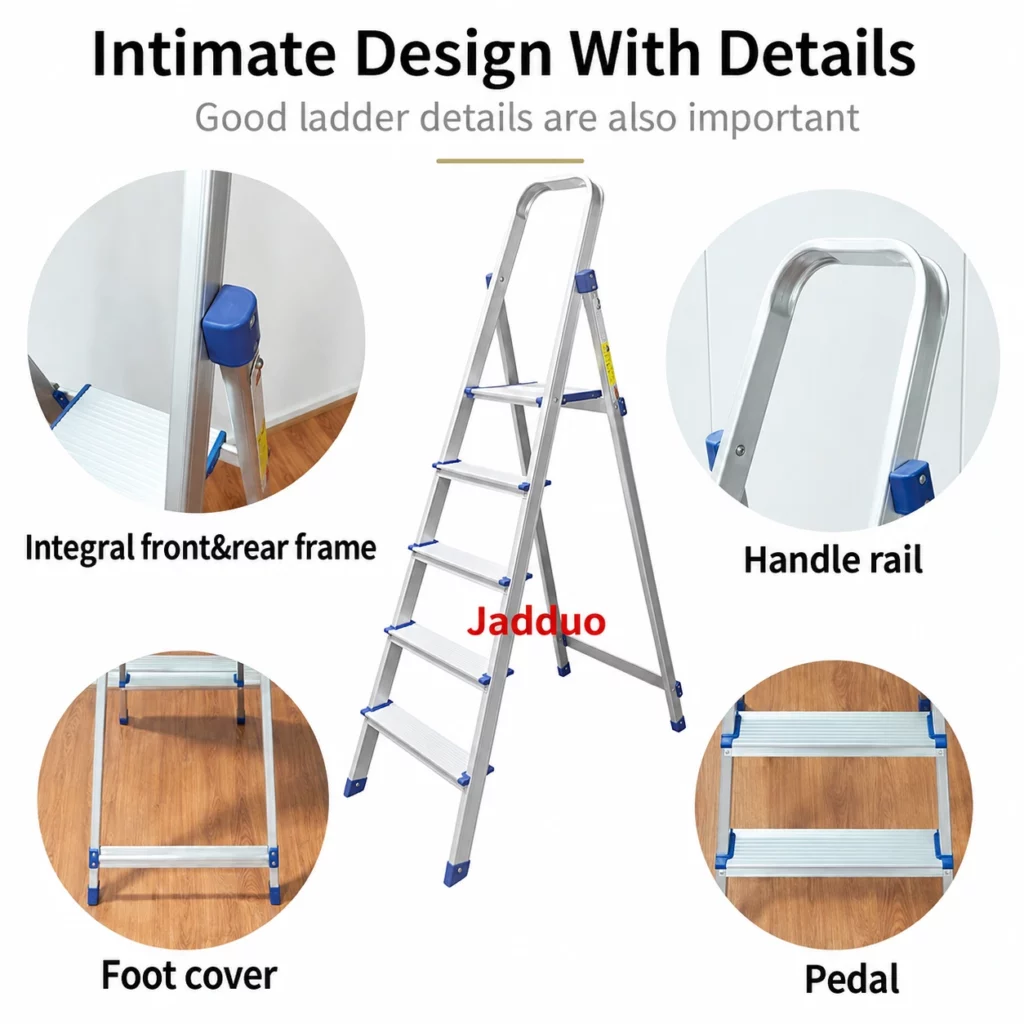
The High Handrail Iron Round Tube Red Step Ladder can be considered where the intended task benefits from a high handrail and broad step surfaces. The listed 2-step, 3-step, and 4-step versions have top-step heights of 48 cm, 72 cm, and 96 cm, and each has a published maximum load of 150 kg.
These figures are product specifications only. They do not establish the highest permitted standing level or prove suitability for a commercial safety program.
Keep Household Ladders Separate From Repeated Professional Use
The Type A Aluminium Household Ladder is explicitly identified as a household ladder. It offers an A-type structure, anti-slip foot covers, non-slip pedals, and 2- to 9-step options, with a published 150 kg maximum load. The 2-step and 3-step versions have top-step heights of 40 cm and 60 cm and gross weights of 2.3 kg and 2.7 kg.
It should be evaluated as a household or light-duty access product unless the exact model carries documentation supporting the intended professional use.
Repeated maintenance, facility work, construction, or industrial tasks may require a product designed and documented for professional duty. A published 150 kg capacity alone is not evidence that a household model satisfies those requirements.
Assess Telescopic Access by Configuration, Not Reach Alone
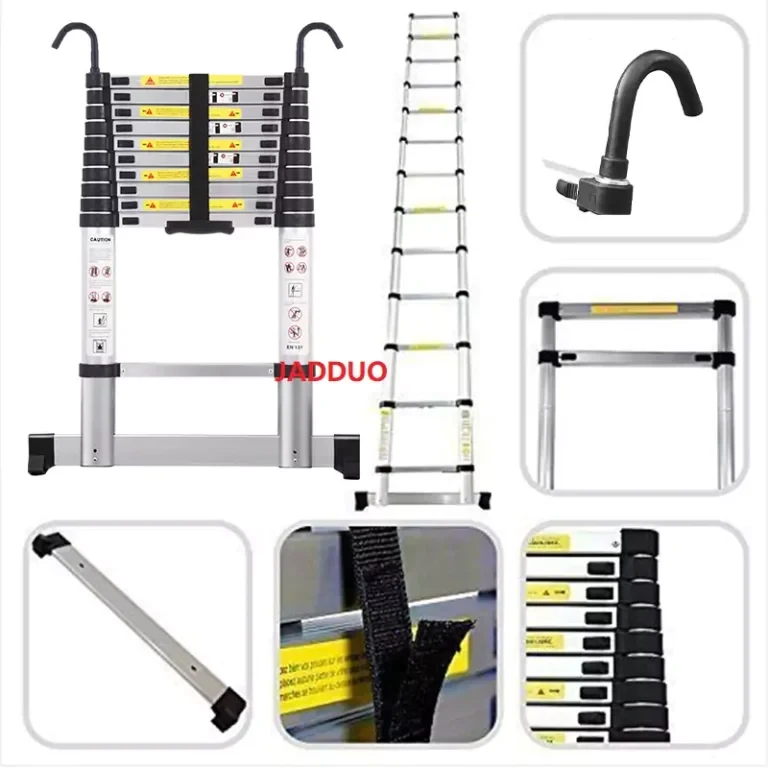
For adjustable reach, the Hook Single Telescopic Ladder with Stabilizer Bar is offered in stated sizes from 2.6 m to 4.4 m and combines telescoping adjustment, removable hooks, and a stabilizer bar. Its published maximum load is 150 kg.
Hooks and stabilizing components must be used only as intended; buyers should not assume that a hook can serve as a roof anchor, rescue attachment, or universal support point without specific documentation.
What Practices Support Controlled Work and Descent?
Set Non-Self-Supporting Ladders at the Correct Angle
For U.S. construction work, OSHA 1926.1053(b)(5)(i) requires a non-self-supporting ladder to be set so the horizontal distance from the top support to the foot is approximately one-quarter of the ladder’s working length. This is commonly described as the 4:1 setup rule, roughly 75 degrees from horizontal.
It does not apply in the same way to a self-supporting A-frame ladder, which must be fully opened and locked according to its design.
Plan Tools, Materials, and Total Load Before Climbing
The maximum intended load is more than the user’s body weight. OSHA 1910.23(c)(3) includes the employee together with tools, equipment, materials, and other forces applied to the ladder.
A product page that lists “150 kg maximum load” therefore provides only one part of the purchasing decision. The exact duty rating, test documentation, user instructions, and task conditions still need review.
Make Descent a Planned Part of the Task
Before descending, stop the task, secure loose items, establish a reliable grip, face the ladder, and descend without rushing. Wet, oily, damaged, obstructed, or contaminated rungs and steps call for an immediate pause.
If the user cannot carry an item without compromising balance, lower or transfer the item by another controlled method.
When Should a Ladder Be Removed From Service?
Workplace procedures should define clear retirement and quarantine conditions. OSHA 1910.23(b)(9) requires ladders to be inspected before initial use in each work shift and more frequently as necessary.
Under 1910.23(b)(10), a ladder with structural or other defects must be tagged as dangerous and removed from service until repaired or replaced. For U.S. construction, 1926.1053(b)(15) requires periodic inspection by a competent person and inspection after events that could affect safe use, while 1926.1053(b)(16) requires defective portable ladders to be identified and withdrawn from service.
Practical removal triggers include cracked or bent rails, broken or missing rungs or steps, damaged locking parts, loose fasteners, corroded structural components, damaged feet, defective ropes or pulleys, damaged hooks or stabilizers, or contamination that cannot be safely removed.
Do not improvise repairs or continue using a ladder simply because it still supports body weight.
How Can Organizations Build Consistent Ladder Procedures?
A repeatable ladder program should begin with a site and task risk assessment. Check the support surface, traffic routes, doors, weather, overhead obstructions, electrical exposure, drop hazards, work duration, required hand use, carried materials, and whether a ladder is the right access method at all.
A platform, scaffold, or other access system may be more appropriate for longer-duration or two-handed work.
A practical pre-use and procurement checklist should cover:
- Exact ladder type and intended application
- Required access point and permitted standing level
- Overall length, top-step or platform height, and working position
- Maximum intended load, including user, tools, and materials
- Feet, rails, rungs or steps, hinges, spreaders, locks, hooks, ropes, pulleys, and stabilizers
- Surface condition, traffic exposure, electrical hazards, and setup angle where applicable
- Model-specific instructions, markings, test reports, and applicable market standards
- Defect reporting, quarantine, repair, replacement, storage, and post-use inspection
For U.S. portable metal ladder purchasing, ANSI ASC A14.2-2017 provides a consensus framework for construction, design, testing, care, and use.
For European portable ladders, EN 131-2:2010+A3:2025, Clause 1, defines the standard’s scope and points to additional parts such as EN 131-4 for hinged ladders and EN 131-6 for telescopic ladders.
Buyers should request model-specific evidence rather than relying on a brand-level statement that products “meet ANSI” or “meet EN 131.”
FAQ
What Should a User Do If the Task Cannot Be Reached Without Leaning?
Stop the task, descend while maintaining control, and reposition the ladder from the supporting surface. Repeated leaning is a sign that the ladder position, ladder type, or permitted standing level does not match the task.
How Should a Buyer Select Ladder Height for Repeated Work?
Start with the access point and task height, then compare them with the exact model’s permitted standing level and setup instructions. Do not use overall ladder length or top-step height as a substitute for the manufacturer’s highest allowed standing position.
Does a 150 kg Maximum Load Prove Commercial or Industrial Suitability?
No. It is a published capacity figure, not a complete duty classification, workplace approval, or proof of compliance with a specific professional standard. Verify the exact model, intended use, test documentation, labels, and local requirements.
For model dimensions, configuration options, and application-specific questions, contact Jadduo before ordering.