Picture a buyer checking a roof-access order. The quotation says the ladder reaches the roofline, yet the fly section is shown almost entirely out of the base. There may be no usable access position at that length. The buyer needs the actual model and its extension limit, then a measurement on an open sample. The longest catalog figure, on its own, is a poor buying specification.
At a glance
A Jadduo two-section extension ladder needs model-specific overlap, engaged rung locks and enough usable length for the intended support or landing.
Overlap is the length shared by the base and fly. Fly section is the sliding upper part. Working length is the usable extended length after the model’s limits are respected.
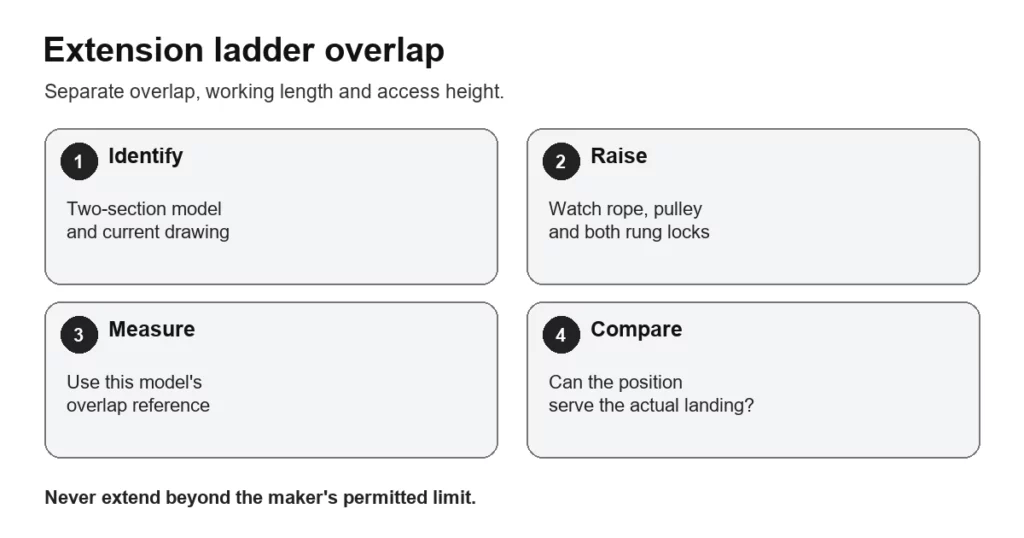
A conventional two-section extension ladder, including a rope-and-pulley model offered by Jadduo, needs a model-specific overlap check. The minimum overlap depends on the product design, length and applicable instructions or standard. Never guess a fixed overlap value from a photograph or apply a number from an unrelated model.
- Separate overlap from access height.
- Check both rung locks.
- Measure the intended working position.
Understand what is being measured
Look at an extended two-section ladder from the side. The portion where base and fly still run together is the overlap. It is easy to mistake the overall length on a sales sheet for usable reach. Write down three separate figures: the maker’s stated extended length, the length permitted with its required overlap, and the height available once the ladder is placed for the job. If the quotation gives only the first, ask for the other two.
For example, a ladder used to access an elevated landing needs suitable extension above the landing as well as adequate section engagement. OSHA’s portable-ladder quick card says a straight or extension ladder used for such access must extend at least three feet above the point of support in the U.S. context. That access requirement is not the same as the overlap between the ladder sections. A supplier should provide the model’s own dimensional drawing and instructions for both questions.
Jadduo’s range distinguishes extension ladders from compact telescopic ladders and self-supporting step ladders. That classification prevents a common inspection mistake. An extending two-section ladder has a fly section and rung locks; a telescopic ladder has many nested section locks. A checklist written for one mechanism cannot establish the other’s engagement.
Choose a real product and a real task
The Jadduo 2 Section Ladder With Pulley and Rope provides a useful example. Request the drawing and current instructions for the SKU under consideration. A salesperson’s answer for a neighboring model is not a measurement of this one.
Describe the job before checking the sample. Then mark where the top would bear and whether anyone must step off. A ladder that reaches the roof edge in a diagram may still be too short for access once its section overlap and the required projection above the landing are preserved.
House maintenance, gutter cleaning, seasonal decoration and warehouse access are common reasons to specify a ladder. The purchase specification should state the intended setting and the responsible site’s safety requirements.
Inspect the two-section sample in stages
Identify components before raising the fly
Then examine the two rails, rung connections and all feet. A rope may look sound at its free end while fraying where it bends around a pulley, so inspect the full route.
Jadduo’s production sequence includes pipe cutting, drilling and stamping or indenting before sleeving, labeling and final assembly. Factory equipment includes tube-expanding, punching and riveting machinery. These process stages explain why a buyer should inspect the assembled relationship between rail holes, rung connections and locks; they do not prove that a production unit has passed a strength test.
Its documented tube route differs by profile: round tubes go through drilling, indentation or stamping and sleeving, while square tubes receive drilling and plastic-sleeve installation. After the respective tube work come labeling, strapping, assembly and packaging. If an extension ladder is quoted with a different rail profile, ask for the drawing and joint details of that variant.
Raise the ladder without loading it
Set the base on a firm, level surface with appropriate support and enough room to work safely. Follow the model’s instructions to raise the fly section. Keep hands clear of the moving section and avoid standing beneath an unsecured fly. Stop at several allowed positions and watch whether the locks seat correctly on both rails. Record a position that requires extra force, produces unequal engagement or lets the fly descend unexpectedly.
Do not climb during a questionable test. The HSE ladder inspection guidance includes loose rungs, damaged stays, loose rivets and damaged joints among defects to look for.
Confirm overlap against the model instructions
At the intended working position, locate the manufacturer’s overlap mark or prescribed limit if the model provides one. Measure the remaining shared section length using the maker’s reference points. If the instructions specify a minimum overlap, record that number and the actual sample measurement. If they do not, ask the supplier for the model-specific instruction rather than inventing a field rule. Also confirm that the fly is oriented as the manual requires; reversing a section can change lock behavior.
The question to answer is simple: can this exact SKU reach the needed support or landing while retaining the overlap and lock engagement its instructions require? If not, specify a longer or different ladder. Do not defeat the stop, rest a section on a marginal last rung or tie two ladders together to gain extra reach. OSHA’s ladder rule prohibits fastening ladders together for extra length unless they are designed for that use.
img.Extension Ladder.webp
Separate overlap from setup angle and access height
Overlap is an internal relationship between sections. Setup angle concerns the ladder’s placement against the support. Access height concerns how far the side rails extend above a landing. A sample can pass one and fail another. Keep three separate entries on the inspection sheet instead of writing a single “height passes” tick.
For a leaning ladder in the OSHA quick card’s U.S. setting, the base is placed about one quarter of the working length away from the wall. That instruction helps establish an appropriate angle. It does not tell you how much of the fly section must overlap the base. The supplier’s model manual remains the source for the ladder’s extension limits, while the worksite rules govern placement and use.
A rope-and-pulley system makes raising a long fly more manageable, but it does not carry the user’s weight by itself. The rung locks and rails must be in the correct positions before the ladder is used. A rope that pulls smoothly can distract an inspector from a lock that only catches on one side. Watch the contact points while the fly settles into place.
For example, a fly that reaches an eave may still be too short for stepping onto the roof once the model’s overlap limit is observed.
Write a specification receiving can check
An effective purchase record includes the exact SKU, intended access height, required working configuration, current manual, load rating, rope path, lock positions and approved packed sample. Photograph the sample at a midrange extension and at the proposed working extension. Include a close view of each engaged rung lock and the overlap reference or measurement. Then a receiving team can compare a random delivered unit with something concrete.
Jadduo offers OEM/ODM supply and negotiable wholesale orders, with quality checks before shipment. For a particular order, put the requested model, inspection method and acceptance evidence into the purchase order. If a customer asks for a changed rope, pulley, rail profile or packaging arrangement, approve a new sample under the revised specification. A previous sample cannot prove that the modified ladder has the same engagement behavior.
At receiving, open a normal carton and check that the product label and manual match the order. Look for transport damage around the pulley, rails and locks. Raise and lower the ladder by its prescribed method and verify the overlap at the intended position. A packed unit that fails this comparison should be isolated for supplier review before the batch is released.
| Measurement | Where it comes from |
| Permitted section overlap | Current instructions for the exact SKU. |
| Intended support height | The actual job, measured on site. |
| Access projection, where required | Applicable site rule and the landing geometry. |
Questions that prevent ordering mistakes
Is the catalog’s maximum length the usable access height?
No. The work position depends on the ladder’s extension limit, support geometry, placement angle and any required projection above an access landing. Request the model’s working-length information and test the planned setup.
Can a buyer use one overlap number for every two-section ladder?
No. Use the current instructions and applicable standard for the exact model and length. A generic value can be too short for a particular design or unnecessarily restrictive for another.
What if the fly locks at different heights on the two rails?
Stop the check and keep the ladder out of use. Unequal engagement is not an acceptable way to gain reach. Record the position and seek a manufacturer-supported disposition.
Make the decision before the ladder reaches a site
An overlap check is most useful before an order is approved, when a longer or different product is still an easy choice. Compare the actual task with the exact model’s permitted extension, its lock engagement and its access setup. Once those three facts are documented on a sample, receiving inspection becomes a repeatable verification instead of a guess based on catalog length.
Review the company profile, then send the needed access height through the contact page.