
A missing ladder foot is a repair question before it is a parts order. Identify the damaged rail, the attachment and the opposite foot before buying a cap.
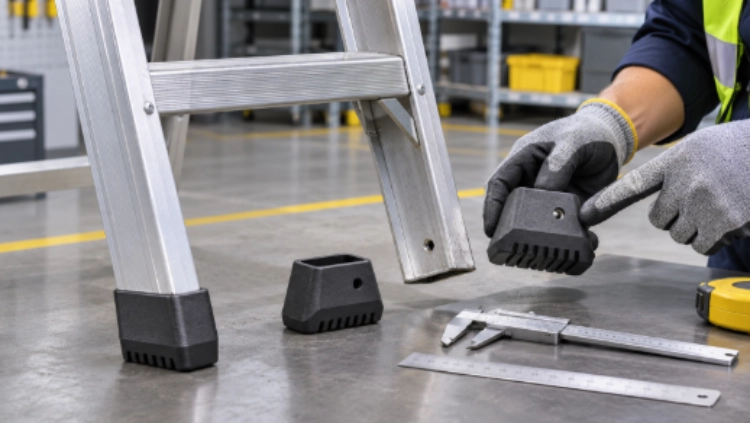
Take the ladder out of use and inspect the whole base
Ladder foot is the part that meets the ground, on a rail or on a detachable bar. Rail insert is the piece that fits inside a hollow tube. Pivoting shoe is a hinged foot on some leaning ladders. Three names, three possible orders; a single underside photo will not tell the supplier which one you need.
Take the ladder out of use while the base is checked. The UK HSE includes feet in its pre-use ladder check, including after a drop or a move from dirty ground to a clean surface.
Check the leg beneath the pad
| Base component | Evidence to photograph |
| Four feet on a stepladder | Each point of floor contact, including the back legs |
| Pivoting shoe on a leaning ladder | Shoe movement and its retaining pin or screw |
| Balance bar on a multi-purpose model | Bar mounting and the feet attached to it |
Know when a new foot is insufficient
The US OSHA construction ladder rule requires a defective portable ladder to be withdrawn until a repair meets the original design criteria. For example, a cap over a bent rail is not a repair to that rail. Show the maker the damage before ordering a foot; if the correct part or approved method cannot be identified, the ladder stays out of use.
Identify the exact ladder before shopping for feet
The product label and one full-ladder photograph identify the model. Keep the damaged and intact base images under that same code.
Match the rail and the attachment
Measure the rail end with the old foot removed only if the maker permits that removal. Include a ruler in each image. For example, a near match in width is insufficient when the retainer or seating depth differs.
| Feature | What the supplier needs |
| Rail shape | Outer and, for an insert, inner profile |
| Fixing | Hole locations, pin or screw, and the maker’s drawing |
| Shoe motion | Fixed contact or pivoting bracket |
| Mating surface | Underside of the old foot and the opposite foot |
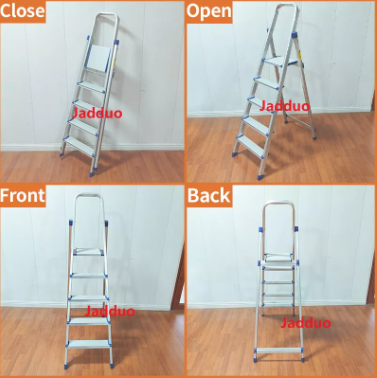
The Jadduo Type A household ladder has anti-slip foot covers. The published two-step and three-step codes are different:
| Step count on the product page | Item code to send with the part request |
| Two steps | H213WY-2-AL |
| Three steps | H213WY-3-AL |
These codes identify the complete ladder rather than the replacement foot assembly. Before ordering, ask Jadduo to confirm whether a replacement cover is available for the exact ladder model and production revision. Request the approved spare-part number and fitting method rather than assuming that another model’s foot cover will fit.
Record the surface the original foot was meant to contact
Compare the underside of the old part with the opposite foot. Uneven tread wear may explain why one corner touches first. Keep both side and underside photographs with the order.
Jadduo’s range includes household, telescopic and multi-purpose ladders. A multi-purpose frame can work as an A-frame or straight ladder; applicable versions also form a double-A or a plate-equipped platform. Some use a detachable balance bar. Record which base touched the ground in the damaged configuration, then identify every approved configuration in which the replacement will also bear weight. A household step-ladder cap should not be assumed to fit a bar-mounted base.
Jadduo describes the balance bar as removable on relevant multi-purpose ladders, with transport wheels available on some configurations. The bar, its foot caps and the optional wheel are different parts. A request for a “replacement foot” should therefore say whether the damaged contact is on the main rail or on the detachable bar. Add a photograph of the bar off the ladder and another with it fitted. The wheel, if present, needs its own item identification; it is not evidence that a foot cap from another model will fit.
The multi-purpose range covers distinct jobs as well as distinct bases. Jadduo gives indoor painting and light replacement as A-frame examples, exterior repair or pruning as straight-ladder examples, and a separate steel plate for a platform arrangement. A double-A setup is another listed form on applicable models. Name the approved form in which the foot failed. The supplier can then compare the damaged contact with the foot arrangement in the other forms that model permits.
Compare the proposed replacement with the original assembly
The table below keeps the original and proposed parts beside the same ladder. A changed revision needs the maker’s compatibility decision; field-drilling a new hole is not that decision.
| What you see | Why it matters | What to ask for |
| Cap seats only halfway | The rail profile or insert depth may differ | A drawing for the exact model and revision |
| Fixing holes miss each other | The retainer cannot work as designed | The correct part number, not a field-drilling workaround |
| Shoe does not pivot like the original | Ground contact may change on a leaning ladder | The complete approved shoe assembly |
| New foot stands higher than the opposite one | The base may not contact the floor evenly | Guidance on replacing the pair or full set |
Inspect the pair, not only the failed side
The HSE stepladder guide calls for four feet down and level steps. Check the base after fitting; ask whether a worn opposite foot requires replacement too.
Keep the old part until the repair is accepted. Its molded marks and hole pattern can resolve a later parts mismatch.
Send the supplier a part-matching request they can answer
One repair ticket may say “rear right foot” while the photograph shows a rail with the ladder folded. Set the ladder up, mark the viewing direction in the picture, then include a second image with its model label. Do that before removing a piece. If the repair department files images by shipment number alone, put the ladder code in the file name as well. A different unit in the same lot should not inherit this one’s replacement bag.
Send one file per ladder model with:
- the product label and a full-ladder photograph;
- the old foot beside a ruler, followed by close-ups of its rail and retainer;
- the rail profile, fixing method and a note on whether one foot or a pair failed;
- a request for the approved part number, fitting method and any instruction to replace both sides.
Jadduo processes round pipes with drilling, indentation or stamping and sleeving; its square-pipe route uses drilling and plastic-sleeve installation. Assembly, labeling and packing follow. A spare-foot request should name the finished model rather than assuming the same cap fits both rail processes.
| Factory detail from Jadduo | Why it belongs in a replacement inquiry |
| Round or square rail processing | Tube profile and sleeve construction can differ |
| Drilled or stamped connection | The original fastener location needs a match |
| Assembly and labeling | The finished model code links the ladder to its part |
| Packing | A part bag can be labeled for receiving and later service |
The Jadduo About Us page gives the manufacturer context, but only a model-specific parts confirmation settles this repair. Use the contact page to send the code, production revision and photographs together.
Ask for a labeled part bag tied to the ladder code and revision. This keeps a distributor’s reorder record attached to the actual ladder instead of a vague “universal foot” description.
Jadduo offers household, telescopic and multi-purpose ladders. Send its team the photographs and model details, and ask it to confirm availability and compatibility. If the foot problem appears in a new shipment, use the site’s wholesale arrival inspection checklist to record the affected lot. Keep the parts inquiry and the shipment claim separate so neither loses its model reference.
Fit and verify before the ladder returns to work
Use the exact fitting method supplied for the approved part. Work with the ladder unloaded. Seat the foot fully and verify every retainer before opening it on a firm, level surface. Look for a gap under a pad, a rail that twists, or a foot that moves when the ladder is opened and closed. A person should never be the first “test load” on a doubtful fix.
Finish with the normal pre-use inspection, including rails, rungs or steps, locks and the whole base. If anything is uncertain, leave the ladder out of service. For a managed fleet, keep the part number, repair date and return-to-use approval with the ladder’s record.
Frequently asked questions
Can I replace only one ladder foot?
Sometimes. The manufacturer must offer a matching single part, and the other feet must still make even contact. Follow any instruction to replace a pair or set. Uneven wear is a reason to inspect the whole base before deciding.
Are all rubber ladder feet interchangeable?
No. The rail profile, fixing method, shoe movement and contact shape vary. Buy for the exact ladder model and revision, then check the repaired base.