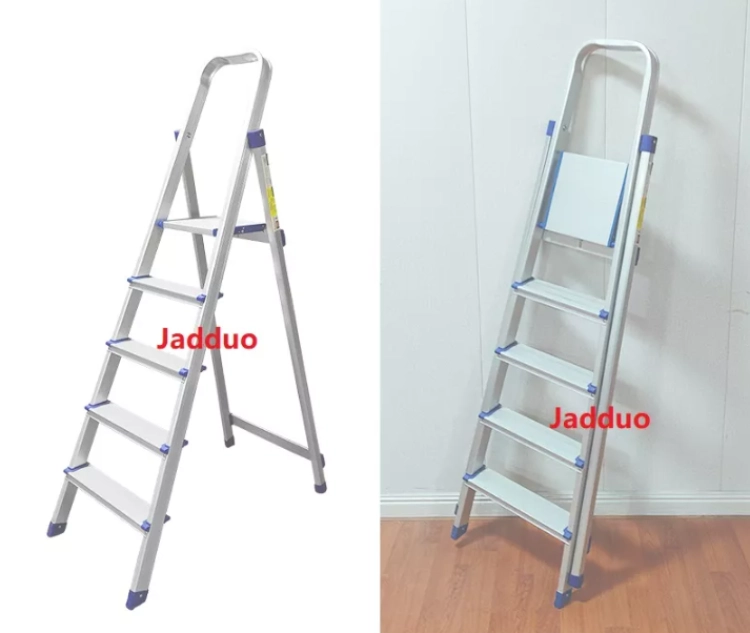
Ten rungs extend with a familiar click; the eleventh settles without one. Close up, one rail end has not latched. That unit cannot be approved on the strength of ten successful rungs.
At a glance: On a Jadduo telescopic sample, count the rungs, verify both ends of every extended section, and repeat the maker’s closing sequence.
Section lock is the device that holds one extended rung. Release control is the mechanism used to close the model. Rung gap is the space between adjacent steps after extension.
A delivery inspector should stop at that rung, write down its position and photograph both rail ends. The sample has to be checked in the same configuration a user will actually climb, with no one standing on it during the inspection.
- Count the moving rung sections.
- Check both ends of each lock.
- Repeat the prescribed closing cycle.
Why the lock check has to be section by section
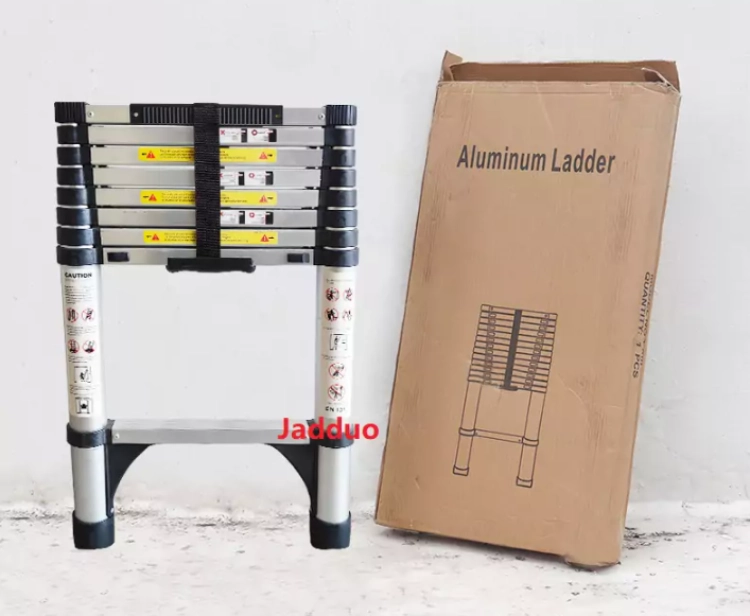
When closed, the rungs and rails nest together. When open, each extended rung adds another locking pair to inspect. A central release control can make closing faster; it cannot tell you, by itself, which rung is secure. The Ladder Association’s guidance calls for checking the lock mechanism of every section before use, with the manufacturer’s instructions at hand.
Compact storage is useful in a service vehicle, a warehouse tool area or an RV. Jadduo offers telescopic ladders for such access needs, alongside household and other ladder types.
Jadduo describes ordinary telescopic ladders as compact enough for spaces such as a cupboard, behind a sofa or in a vehicle trunk; a larger multipurpose frame may instead need garage or tool-room space. Its product guidance also treats safe locking as a primary buying factor and distinguishes anti-slip foot covers from an optional balance bar on relevant designs. A buyer should record the folded dimensions and the supplied base parts of the actual model, rather than assume that every compact ladder has the same kit.
The hinge controls a configuration. The section lock holds a particular telescoped length.
This distinction matters on an order sheet.
Identify the exact model before pressing a button
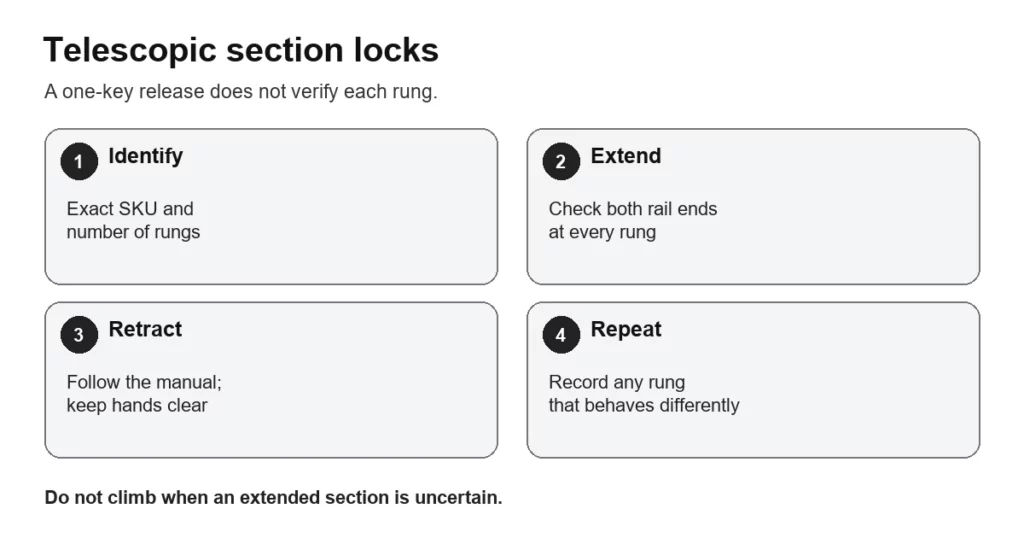
“Locks passed” without a model and rung count leaves a later inspector unable to repeat the review. The longer sample has more latch points to see and photograph; a result copied from the shorter one does not cover them.
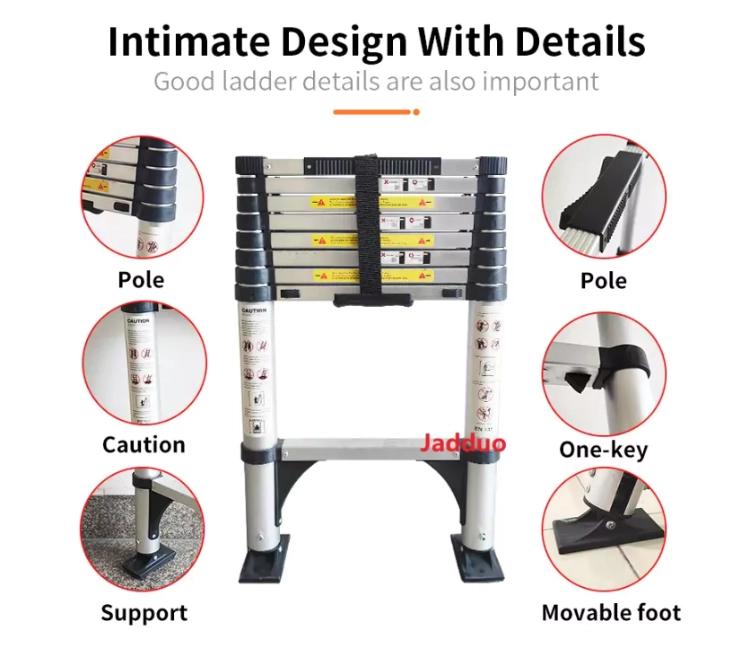
The Jadduo One-key Telescopic Ladder with Round Foot is listed in lengths from 2.0 m to 3.8 m. The page describes a central retraction button and locks at the rungs. Ask which listed item number will ship, then obtain that model’s instructions. A distributor who approves the 2.0 m unit has not inspected the additional joints on the 3.8 m unit. Nor does this central button describe how every other Jadduo telescopic model closes.
The product listing puts seven rungs on the 2.0 m version and thirteen on the 3.8 m version. It gives closed lengths of 68 cm and 87 cm, and net weights of 4.8 kg and 10.7 kg respectively. Both rows show a 150 kg maximum load. The marked load includes the person and anything carried while climbing. Compare the intended task with that limit on the actual unit. Check the physical markings and the evidence relevant to the ordered market; these catalog values help identify the unit, but they cannot verify a latch.
The item codes on the same listing make the comparison more precise: JDT1020-ONE-DXGKJ is the 2.0 m version, while JDT1038-ONE-DXGKJ is the 3.8 m version.
Keep separate photographs and notes. A single pass result for the seven-rung model leaves the thirteen-rung model’s additional locks unexamined.
Consider a receiving desk with one carton of each length. The folded units come out first, still carrying their model labels. Lay the two instruction sheets beside them and check the item codes before opening either ladder. Record the right and left latch result at each extended rung on separate sheets. If the longer ladder stops at rung eleven, the shorter ladder’s successful test says nothing about that failure.
Jadduo’s range includes aluminium and telescopic products, with wholesale and OEM/ODM supply. For a modified order, ask which mechanism, labels and instructions will ship with the modified ladder.
If a buyer changes the rung count or control layout, the sample and paperwork must change together.
Run a repeatable sample check
Inspect before extension
Jadduo’s documented production sequence includes tube cutting followed by drilling, indentation or stamping and sleeving where the tube form requires it, then assembly and packaging. The locking path depends on formed openings and aligned components. Process variation may appear during a physical check as inconsistent movement, abnormal gaps or a latch that engages later on one side.
If rung seven on the right lags once in three cycles, production staff have a location and frequency to investigate. “Sometimes sticks” gives them neither.
Extend according to the manual
The Ladder Association’s detailed guide tells users to check both ends of each extended rung and to avoid use when sections sit incorrectly or their gaps differ. That is more exact than listening for a run of clicks.
Close, reopen and compare
Move your hands away from the closing gaps and follow the retraction sequence. Watch the section immediately above the release point: does it descend gradually, catch or drop?
The closing test also exposes handling problems a catalog cannot show. Watch where an operator naturally places a hand before pressing release. If the instructed grip is unclear, the manual needs clarification before distribution. Closing gaps can trap fingers. A buyer should read the actual leaflet, operate the sample as printed, and identify where the instructions leave the user guessing about hand position.
Jadduo’s one-key product page tells users to press the central retraction button and gently guide the ladder down. That is specific to the listed one-key product.
Check the rest of the load path
The HSE pre-use inspection page directs users to inspect stiles, feet, rungs and locking mechanisms and to keep defective ladders out of use.
A central release button is not a substitute for a stable base or an authorized access arrangement. For U.S. construction use, OSHA’s portable-ladder quick card includes placement, access and load guidance; a buyer in another market should check local rules as well.
Turn the test into a purchase specification
| Observation to record | Why it matters at receiving |
| Rung number and left/right engagement on each opening | An intermittent fault needs a repeatable location, not “sometimes sticks.” |
| Retraction order and hand position shown in the supplied manual | A different leaflet can describe a different release mechanism. |
| Rail straightness, foot condition and sliding clearance before opening | A good latch cannot make a damaged or contaminated structure sound. |
| Photo of extended state plus closed state | Both ends of the operating cycle must match the approved sample. |
Jadduo’s factory equipment includes pipe-cutting, punching, riveting, tube-expanding and injection-molding machines.
An acceptance sheet can use two columns: what the sample did and what the paperwork promised. Put “both rail ends engaged at every extended rung” beside a photograph set, not just a tick. Put the closing sequence beside the manual revision.
At receiving, take a unit from a normal carton and repeat the same sequence. A showroom sample and a production unit should not require different instructions.
| Checkpoint | Acceptable record |
| Item identity | Label, carton and manual name the same SKU. |
| Extended rung | Left and right locks are checked separately. |
| Second cycle | Any change in operation is noted by rung and side. |
Common questions
Is hearing a click enough?
No. One click may come from the previous rung. Look at the two ends of the rung just extended and use the check shown in that model’s instructions.
Can a sticky lock be lubricated on site?
The answer belongs in the manual for that SKU. If it gives no cleaning or lubrication method, ask the maker before putting anything into the latch housing.
Can the user skip sections to get a shorter ladder?
Only if that model’s instructions permit the resulting configuration and explain which sections must remain extended or closed. Do not extrapolate from a different telescopic design.
The approval decision
Approve the identified model only after its locks and release sequence pass repeated checks against the supplied manual. Keep the signed record beside the purchase order.
Use the company profile for context and the contact page for a model-specific lock query.