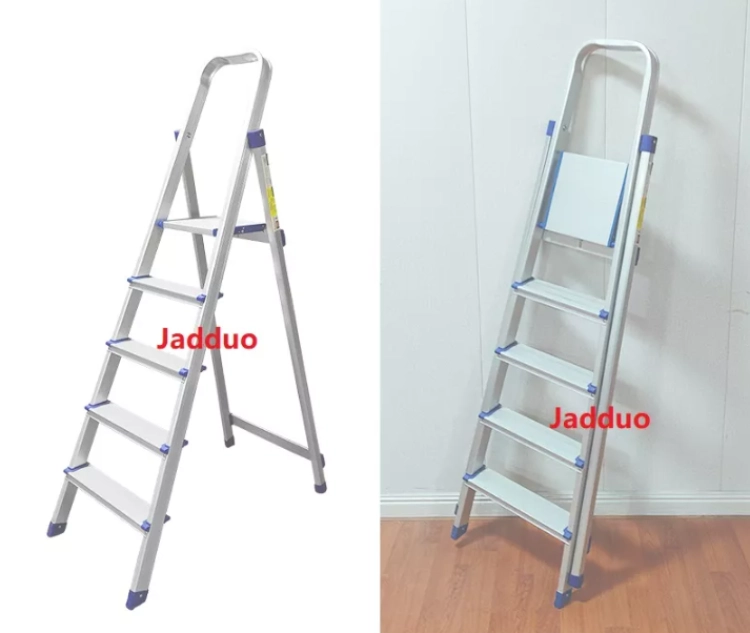
On a sample-room floor, two step ladders may look identical from the front. Walk around them. On one, the left spreader has reached its stop; on the other, the right arm is still a few millimeters short. That difference is invisible in a folded product photograph. Open the ladder yourself, using its instructions, and look at both sides before deciding whether the sample is ready for an order.
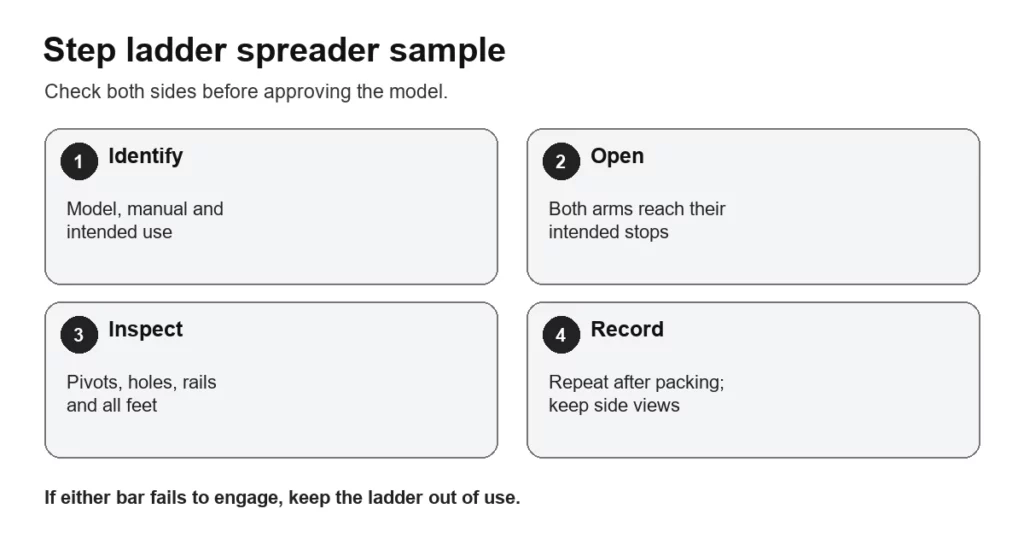
At a glance: For a Jadduo step-ladder sample, verify both spreader arms after opening, inspect their four attachments, then repeat the check on a packed unit.
Spreader bar is the front-to-rear opening restraint. Pivot is its moving connection to the frame. Open stop is the position where the model says the arm should seat.
It helps a purchasing team sourcing from Jadduo decide whether a sample deserves approval and helps a user recognize a ladder that should be withdrawn. It is not a repair procedure. A damaged structural part calls for the manufacturer’s assessment and an authorized remedy, not an improvised pin, bolt or tie.
- Check the exact step-ladder model.
- Watch both spreaders engage.
- Compare the packed production unit.
What the spreader is supposed to do
Open a step ladder and look halfway down the side. The arm between the climbing side and the rear frame is its spreader. It holds the two frames apart at the intended opening. OSHA’s U.S. construction rule requires a metal spreader or locking device on each stepladder used in that setting. For another market, specify the applicable standard and product category in the purchase order; the U.S. rule is useful context, not a universal certificate.
Follow it from its pivot to the frame attachment, including the stop and retaining hardware. A nearly seated arm can leave the front view looking ordinary. Take a photograph from each side at the same level; it is much easier to compare the two joints that way. A sound from the left side says nothing conclusive about the right.
The design is different from a stabilizer bar fitted to the bottom of a leaning ladder. A spreader restrains the opening of a self-supporting frame. A stabilizer changes base support.
Start with the actual task and model
Confirm the ladder category
First record whether the proposed ladder is a household step ladder, a professional model, or a convertible ladder with more than one approved configuration. Also record the highest permitted standing step: the top cap or top step of a conventional stepladder is not automatically a standing surface.
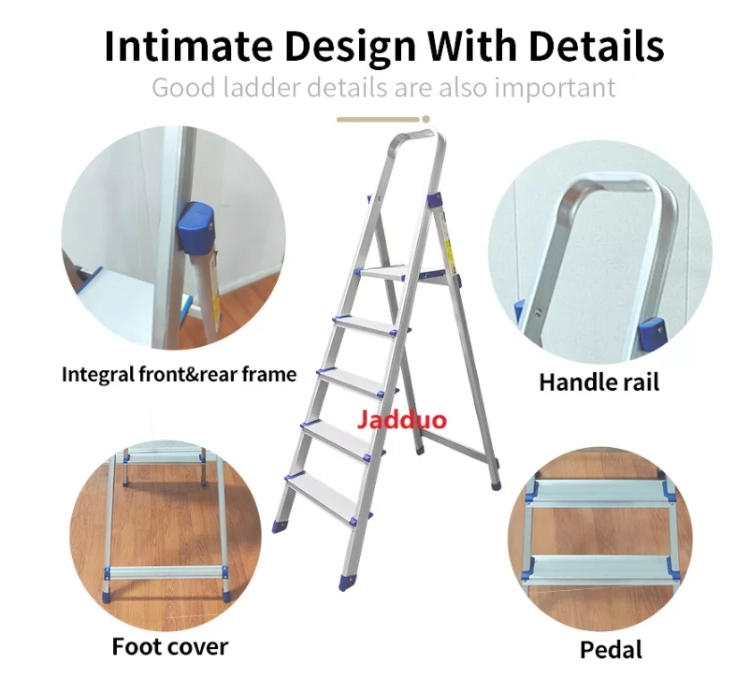
As a model-level reference, the Jadduo Type A Aluminium Household Ladder lists 2- to 9-step options, anti-slip treads and foot covers, and a published 150 kg maximum load. Its listing describes a household ladder. A buyer seeking a professional-use batch should request the documentation for the proposed professional model instead of transferring the household listing’s claims to it.
Match the sample to the purchase order
For example, the Type A listing distinguishes the two-step H213WY-2-AL and three-step H213WY-3-AL by open height and top-step height.
Jadduo offers freestanding A-frame step ladders alongside telescopic, platform, extension and fiberglass lines. That distinction matters during inspection. A hinged multipurpose model can have several locks, while the conventional step ladder here needs its own front-to-rear opening device checked in its prescribed position.
In Jadduo’s multipurpose range, an applicable frame can be arranged as an A-frame for indoor painting or light replacement, a straight ladder for exterior work or pruning, and, with a separate plate, a platform. Some versions also form a double-A. Those arrangements create a different inspection map from a single-purpose step ladder: the hinge positions, plate and any detachable balance bar must correspond to the ordered kit.
Some Jadduo multipurpose models use a detachable balance bar, and a moving wheel can be purchased separately. Those parts are not the fixed front-to-rear spreader on a conventional step ladder. Jadduo also describes compact household or ordinary telescopic ladders for cupboard or vehicle-trunk storage, while larger multipurpose frames may need a garage or tool room. These differences should appear on the item and accessory list before a sample is approved.
A five-minute opening test
Place and open without forcing it
Move the two frames apart in the sequence shown in the manual, slowly enough to see whether one arm catches on a tread or a fastener.
Are both arms at the positions shown in the instructions? Does either pivot have a retainer sticking out?
Check the attachments, not just the arms
A straight bar can hide a damaged attachment. Check the material immediately around both ends: an elongated hole, fresh scraping or metal dust is more informative than the bar’s appearance. Perhaps one joint shifts only on the second opening.
Jadduo’s documented production sequence includes cutting tubes, drilling, stamping or indenting as appropriate, installing sleeves, then assembly and packaging. Those steps make hole position and final assembly relevant to a sample check: a poorly aligned hole cannot be cured by a clean carton. The factory equipment inventory includes punching and riveting machinery. The physical sample and its model documentation must still establish that the particular spreader joint is sound.
Check the whole open frame
The HSE pre-use checklist specifically calls for checks of stiles, feet, rungs, locks and stepladder treads. It says locking bars should be fully engaged and defective ladders should not be used.
A sample should also be checked after transport. The HSE calls for a fresh check after an event that could alter condition, including a move from dirty ground to a clean surface.
For foot-condition issues beyond the spreader, Jadduo has a ladder foot replacement guide.
For example, a bar that seats on the showroom unit but catches after unpacking should be recorded as a different acceptance result.
What to put in a supplier acceptance record
Keep the acceptance form to one page. Attach a full-open view from either side and close views of the four spreader connections. Record the SKU, carton mark, manual revision and date. Use observations a second inspector can repeat: “right rear pivot moves,” or “left arm stops before the latch.” The words “looks fine” will not help when a production unit arrives three months later.
Ask the supplier to show the intended open position and approved replacement process in the instructions. Jadduo offers OEM/ODM supply and negotiable wholesale orders; that makes a documented, model-specific sample especially useful when a buyer changes a component or packaging instruction. The buyer should request the current drawing and part identification for the actual order rather than assume a modification preserves the original testing scope.
Jadduo’s company profile gives a 15–30 day production lead-time range and describes quality checks before shipment. Confirm the timing for the ordered SKU and destination. Agree the acceptance criteria before production and then compare a production unit with the approved sample. That prevents an attractive prototype from becoming the only evidence of a batch’s spreader behavior.
| Sample observation | Buyer decision |
| Both arms seat at the documented stops | Continue to rail, tread and foot checks. |
| One pivot shifts or a hole is distorted | Hold the sample and request a corrected assembly. |
| A detachable balance bar is in the kit | Record it separately from the step-ladder spreader. |
When to reject or withdraw a ladder
Reject a sample or withdraw an in-service ladder if a spreader does not lock, a joint is loose, hardware is missing, or a bar or rail is bent. Do the same if a step, foot or another load-bearing component is damaged. OSHA’s portable-ladder safety guidance explicitly warns against use where spreader bars lack a locking device or mechanism.
Such a workaround changes the geometry and gives no evidence of the load path. If a delivered batch contains the same defect on several units, isolate the batch and identify the shared item number and production lot.
Questions buyers often ask
Does a fully opened frame prove the bars are locked?
No. Check the intended engagement point at each side. A frame can reach roughly the right angle while one bar has not seated. Follow the model instructions for the visible or tactile confirmation method and check both sides before use.
Can a loose pivot simply be tightened?
Only when the manufacturer provides an approved procedure and compatible parts for that model. A riveted structural joint, distorted hole or cracked rail is not a general hardware-store fix. Remove the ladder from service while the defect is assessed.
Should every sample receive the same force test?
No. A purchasing inspection verifies identification, assembly and normal operation. Formal strength and durability tests belong to the applicable product standard and should be supported by model-specific documentation. Do not invent a field load test that could damage an otherwise acceptable unit.
A better purchase decision
A buyer who records the SKU, both joints and the exact defect can make a defensible approve-or-reject decision. A user who finds a questionable bar should stop there and keep the ladder out of use until its manufacturer-approved condition is restored.
The company profile identifies the supplier; the contact page can receive the sample’s joint record.