Choosing a telescopic ladder for commercial use should begin with the application, not the price or maximum extended length. Buyers need to compare access requirements, placement conditions, load information, closed dimensions, handling needs, and packaging data. A compact model may suit a mobile maintenance team, while a longer ladder may be more appropriate for a fixed facility.
Commercial buyers should base decisions on verified specifications and current operating instructions. Jadduo manufactures commercial-grade telescopic ladders across heavy-duty aluminum and stainless-steel configurations, defined by precise reach limits, retracted dimensions, and certified load capacities. These catalog details support comparison, but the purchasing record should retain the exact SKU, current specification sheet, and operating instructions.
What Commercial Tasks Must the Ladder Support?
Before comparing products, document where, how, and how often the ladder will be used. This helps procurement teams narrow the shortlist and provide suppliers with clear requirements.
Define the Work Environment and Frequency of Use
Identify whether the ladder will support property maintenance, facility inspections, installation work, outdoor construction support, or elevated warehouse access. Indoor and outdoor locations may have different requirements for material selection, placement, transport, and storage.
Record how frequently the ladder will be deployed, the floor space available, and the surfaces on which it will stand. Any statement about suitability for a particular environment should be checked against the manufacturer’s instructions and the requirements of the destination market.
Match Ladder Length to the Required Access Point
A stated straight ladder length is not the same as a confirmed safe working height. The user’s position, ladder placement, access point, and manufacturer guidance all affect model selection.
Measure typical access points at each site before comparing 2.6 m, 2.9 m, 3.2 m, or longer models. If the ladders will be distributed across several facilities, list each location’s access requirements separately. Selecting one model based on a single measurement may leave some teams with unsuitable equipment.
Account for Transport and Storage Constraints
For vehicle-based teams, compare the closed size, gross weight, securing features, and packing dimensions. These specifications affect loading, unloading, carrying, and storage in vans or maintenance rooms.
Warehouse and distribution buyers should also examine shipment-level packing information. A telescopic ladder may fit the access task but still cause procurement problems if its carton dimensions are unsuitable for existing racking, containers, or distribution processes.
Which Specifications Should Buyers Check First?
Once the application has been defined, assess each specification in context. Use data from the exact model page, product label, specification sheet, or approved operating document.
Review Load Information, Width, and Step Count
Verify the stated maximum load while accounting for the user and any tools being carried. Do not add an assumed safety margin or treat the listed load as permission to use the ladder under unsuitable conditions.
Width and step count are useful comparison points, but neither independently confirms comfort, stability, or safe operation. Review both as part of the overall ladder design and alongside the relevant operating instructions.
Compare Extended, Closed, and Packed Dimensions
Straight ladder length helps buyers shortlist models for a defined access task. Closed size indicates whether the unit will fit in a vehicle, storeroom, or equipment cabinet. Packing size is important for warehouse planning, freight calculations, and distribution.
State meters and centimeters clearly in purchasing documents. A unit-conversion or transcription error could result in unsuitable ladders, cartons that do not fit the intended storage area, or inaccurate logistics calculations.
Examine Stability and Retraction Features
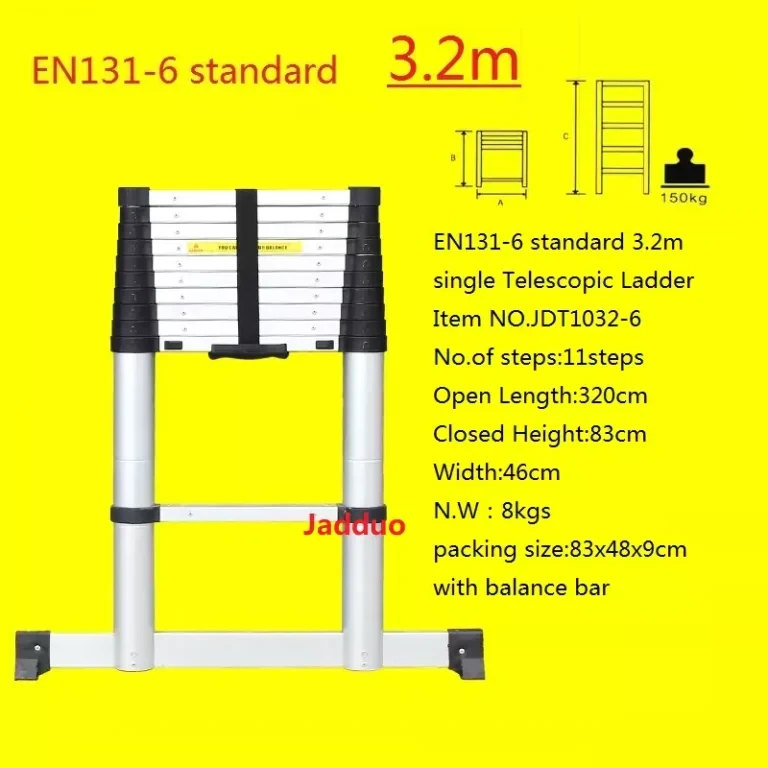
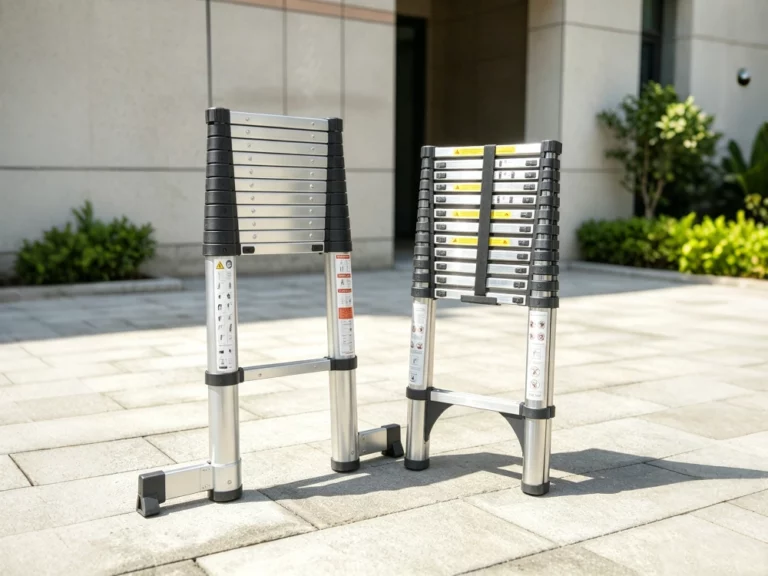
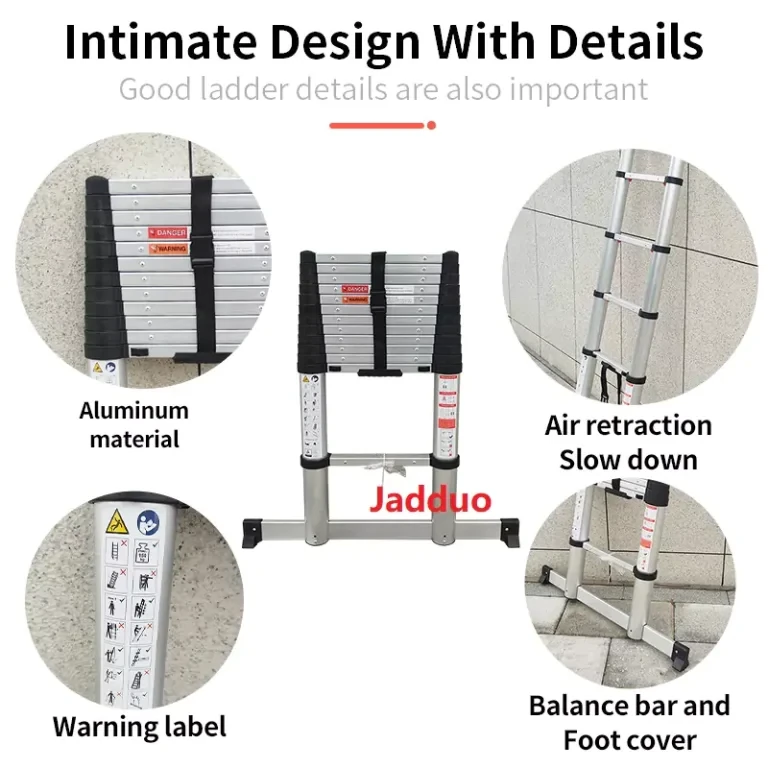
Check for documented features such as a detachable stabilizer bar, slowed closing, a securing strap, and visible warning labels. These details can affect deployment, handling, and storage, but they cannot make poor placement or misuse safe.
The ladder should be used according to the approved instructions and placed on an appropriate stable surface. Buyers may request current operating documentation through Jadduo’s official contact channel before confirming an order.
How Should Materials and Operating Features Be Compared?
Compare material alongside gross weight, dimensions, operating conditions, transport routines, and purchasing priorities.
Evaluate Aluminum Alloy and Stainless Steel Options
Jadduo offers both aluminum alloy and stainless-steel telescopic ladder models. Buyers should compare the exact model’s gross weight, closed dimensions, corrosion-performance evidence, operating limits, and maintenance requirements before selecting a material. The aluminum alloy models emphasize low carrying weight and rapid deployment, whereas stainless steel variants provide enhanced corrosion resistance in aggressive chemical or outdoor environments.
These descriptions do not establish that either material is universally better. Compare equivalent test data under the same conditions, evaluate a sample in the actual workflow, and confirm the exact operating documents before committing to volume purchasing.
Consider Portability for Mobile Commercial Teams
Gross weight, closed length, folding design, and the securing strap can affect how a ladder moves through an organization’s workflow. Confirm that the folded unit fits the assigned vehicles and that employees can load and store it in line with workplace procedures.
Before placing a volume order, assess a sample during actual loading, carrying, deployment, retraction, and storage tasks. Product weight alone should not be used to assume individual handling capability.
Include Inspection and Maintenance in the Buying Decision
Procurement planning should cover routine checks of the ladder body, steps, extension or locking components, stabilizer bar, strap, labels, and overall visible condition. Inspection intervals and maintenance procedures must follow the manufacturer’s approved instructions.
Remove the ladder from service if damage or abnormal operation is observed. Seek qualified guidance rather than improvising repairs or replacing structural components with unapproved parts.
Which Jadduo Telescopic Ladders Fit the Shortlist?
The following documented products illustrate key comparison points; neither should be assumed to suit every application.
Aluminum Alloy One Time Folding Telescopic Slow Down Ladder
The Aluminum Alloy One Time Folding Telescopic Slow Down Ladder has aluminum alloy construction, a folding design, a slow-down operating feature, a securing strap, and a detachable stabilizer bar.
Model JD-T1026-6-H553 has a 2.6 m straight length, 74.5 cm closed size, 75 × 50 × 9 cm packing size, 46 cm width, 6.6 kg gross weight, nine steps, and a stated 150 kg maximum load.
Model JD-T1029-6-H553 extends to 2.9 m, closes to 78.5 cm, weighs 7.4 kg gross, and has ten steps. It has the same stated maximum load.
H552 Stainless Steel Space-Saving Telescopic Ladder Step Space 30cm
The H552 Stainless Steel Space-Saving Telescopic Ladder Step Space 30cm features corrosion-resistant construction, non-slip rungs, and standardized 30 cm rung spacing.
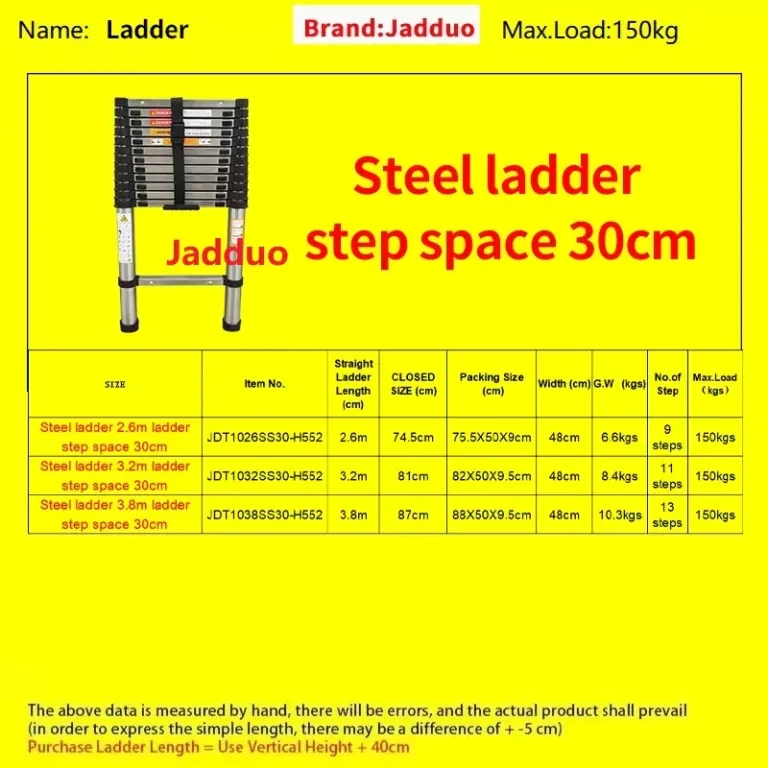
Model JDT1026SS30-H552 has a 2.6 m straight length, 74.5 cm closed size, 75.5 × 50 × 9 cm packing size, 48 cm width, 6.6 kg gross weight, nine steps, and a stated 150 kg maximum load.
Model JDT1032SS30-H552 extends to 3.2 m, closes to 81 cm, weighs 8.4 kg gross, and has eleven steps.
Validate the Model Before a Volume Purchase
Request the current specification sheet, operating instructions, packaging information, and quotation for the exact item number. Confirm dimensions, load listing, accessories, order quantity, destination, and shipping requirements in writing.
A sample evaluation can show whether the chosen telescopic ladder fits the intended access points, vehicles, storage areas, and deployment process. For model comparisons, submit the application and packing requirements through Jadduo’s commercial inquiry channel.
FAQ
What telescopic ladder length is suitable for commercial maintenance?
Match the stated straight length to the measured access point, placement conditions, and exact model instructions. Do not convert ladder length into an assumed working height without approved manufacturer guidance.
Which specifications should be confirmed before ordering in bulk?
Confirm the item number, straight and closed lengths, width, gross weight, step count, stated maximum load, packing dimensions, operating instructions, accessories, quantity, destination, and shipping requirements.
Should a commercial buyer choose an aluminum alloy or stainless steel telescopic ladder?
Compare the documented model attributes, weight, dimensions, storage needs, operating conditions, and procurement priorities. Neither material is universally preferable, so evaluate a sample in the actual workflow before committing to volume purchasing.